

Around day five, you will probably hate your surgeon. Not personally, maybe, but the decision. The swelling will be at its peak. You will look worse than you did before the procedure. You will be in more discomfort than you expected. The result you paid for will be invisible under fluid and inflammation, and it will be genuinely difficult to believe it exists. Almost every cosmetic surgery patient hits this window, and almost none of them were warned about it in enough detail to actually be prepared for it.
Quick Answer
Days 3-10 post-surgery are almost universally the hardest emotionally and physically. Swelling peaks, bruising is most visible, and the result is hidden. This window is predictable, it is physiologically normal, and it ends. Knowing it is coming is the main preparation. The practical work, setting up the recovery space and arranging coverage, is what makes the window survivable.
Looking for a quick answer? Jump to the FAQ below.
The Pre-Op Anxiety Is Real
In the 24-48 hours before surgery, most patients experience some version of “what have I done.” This is not a signal that the decision is wrong. It is a signal that your nervous system understands you are about to undergo a controlled physical trauma, and that it would prefer you reconsidered.
This feeling is so common that surgeons have stopped being surprised by it. What helps: having a plan. Not an abstract sense that things will work out, but a specific plan. Who is picking you up. Where you are going afterward. What is set up at home. What you will eat that first day. When your follow-up appointment is. Patients who have a clear operational picture of the next 72 hours report less pre-op anxiety than patients who have vague positive feelings about the outcome.
What does not help: spending the night before surgery reading negative patient forums. Whatever the worst outcome someone has described on the internet, it is now in your brain. You will not retrieve useful information from those forums at midnight before your procedure. Close the tab.
The Ugly Duckling Phase: What It Is and Why It Happens
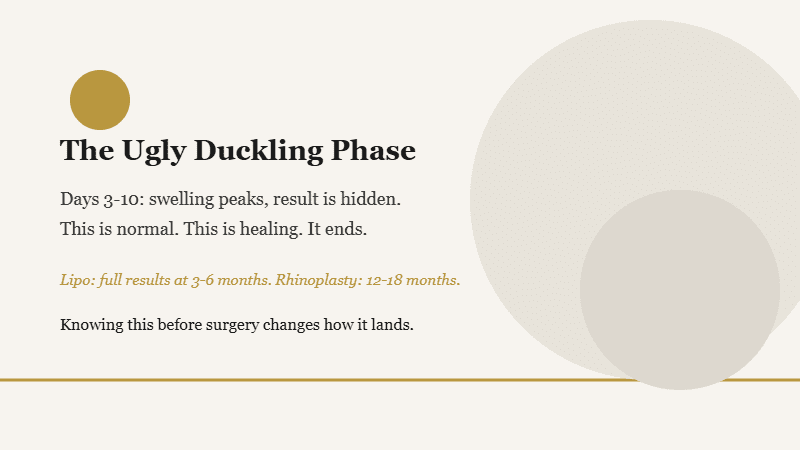
This is the part surgeons talk about among themselves and sometimes warn patients about and are often not specific enough about. There is a window, typically days 3-10 post-surgery, where the gap between how patients look and how they expected to look is widest. Surgeons call it different things. Some call it the ugly duckling phase. Some just say “you will hate me for about two weeks.”
Here is what is actually happening: the swelling is inflammation, and inflammation is how healing works. The tissue was traumatized during the procedure. The body responds with a cascade of fluid and immune activity that causes swelling, heat, and redness. This is not the body failing; it is the body doing exactly what it is supposed to do. The result is hidden under that inflammation, not absent. Patients who understand this physiology report handling the window significantly better than patients who did not know it was coming.
Post-surgical swelling typically peaks within the first few days and then gradually resolves over weeks and months. The timeline is procedure-specific, but the pattern is consistent. The discomfort gets better before the swelling fully resolves.
What’s Normal
- Feeling emotionally low at days 3-7, questioning the decision
- Swelling that makes you look worse than before the procedure
- Significant fatigue and a need to sleep more than usual for 1-2 weeks
- Difficulty with the inactivity restrictions, especially for active people
When to Call
- Persistent depression or anxiety that interferes with basic functioning beyond the first two weeks
- Feeling that the result has made your relationship with your body worse, not better
- Any signs of physical complication: fever, increasing redness, wound separation
- Thoughts of self-harm or harming others at any point during recovery
Realistic Timeline Expectations
One of the most reliable causes of post-surgical distress is a mismatch between expected and actual timeline. Patients who are told “you’ll see your results in a few weeks” and then find themselves at three months still seeing significant swelling have a specific kind of panic that is entirely preventable with accurate information.
Liposuction results typically require 3-6 months to fully show as swelling resolves. At two weeks, you are not seeing your result. At six weeks, you are seeing a partial result. At three months, most of the picture is visible. Some patients see continued improvement at six months.
Rhinoplasty is longer. Final results from a nose job take 12-18 months because the tissue involved heals more slowly and the swelling resolves in stages. Patients who expect to see their result at three months will be disappointed. Patients who knew it was an 18-month process are not surprised.
Botox is shorter. Effects are visible at about two weeks when the full result settles. If you evaluate at day 5, you are not seeing the final picture.
For the specific experience of why things look larger or different than expected in the first few weeks after liposuction, the article on why you look bigger after lipo covers the physiology in detail. Reading it before your procedure, not after, changes how that experience lands.
The Practical Setup: What Actually Makes Recovery Bearable
The unglamorous part of preparing for cosmetic surgery recovery is setting up your physical space before the procedure. Patients who do this spend less cognitive energy on logistics during the hardest days and can rest instead of problem-solve.
Pillows. More than you think. For many procedures you will need specific positioning: elevated, propped, avoiding pressure on certain areas. Having extra pillows in different sizes costs almost nothing and matters considerably in the first week.
Medications collected and organized before surgery day. Your prescriptions, if any, filled. Over-the-counter pain relief, arnica if you use it, everything in one place. Not something to figure out while recovering.
Loose, comfortable clothing that can be removed without raising arms above the head or complicated maneuvering. Button-fronts, zip-ups, loose waistbands. This is especially relevant for any body procedure.
Food that requires no preparation. Protein-forward but easy to eat: Greek yogurt, pre-cooked chicken, eggs, soups. You will not feel like cooking and you should not be standing at a stove for the first few days.
Coverage for responsibilities. Work, children, pets, whatever your schedule contains that you cannot simply pause. Arrange for more coverage than you think you will need. Patients consistently underestimate how much energy the first week takes and overestimate how functional they will be.
For compression garment preparation specifically, the decisions about what to wear post-lipo matter starting before surgery. See the faja sizing guide for what to order before your procedure so it arrives on time. For tummy tuck-specific recovery preparation, the tummy tuck recovery guide covers the full timeline.
| Timeframe | What to Prepare |
|---|---|
| 1 month out | Research recovery timeline for your specific procedure; order compression garments if needed |
| 2 weeks out | Arrange work and childcare coverage; fill prescriptions; prepare the recovery space |
| 1 week out | Stock easy-to-eat food; organize medications; prepare loose clothing; read this article |
| 48 hours out | Stop alcohol and anything on the pre-op stop list; do not read negative forums |
| Day before | Confirm logistics: driver, post-surgery location, follow-up appointment |
| Days 3-10 | This is the hard window. It is normal. It ends. Focus on rest, not evaluation. |
Expectations, Honesty, and the 5-Year Question
Cosmetic surgery can produce meaningful, lasting results. That is true. It is also true that it cannot fix external circumstances, resolve relationship problems, or address underlying dissatisfaction with self that is not specifically about the thing being changed. Surgeons who are doing their job well ask about this before agreeing to operate. Some patients are surprised by those questions. They should not be.
A useful question to ask yourself before surgery: Will this result still matter to me in five years? Not in terms of whether it will look the same, but whether the thing you are trying to change is the kind of thing that changes anything meaningful for you long-term. If the answer is yes, that is useful information. If the answer is uncertain, that is also useful information worth sitting with before the surgery date.
When Feeling Low Crosses Into Something Else
Feeling emotionally difficult during the first two weeks of recovery is expected. It is so expected that it is essentially a predictable phase rather than an exception. Feeling genuinely depressed, experiencing significant anxiety that does not resolve as the physical symptoms improve, or finding that the result has created a worse rather than better relationship with your body are different. Those experiences are worth discussing with a doctor or mental health professional.
Active individuals consistently find inactivity restrictions among the hardest part of surgical recovery. If your identity is connected to exercise or physical activity, plan for that specific challenge. Having something to substitute, short walks when cleared, reading, low-key social connection, anything that gives the day structure without physical demand, reduces the psychological weight of the restriction period.
The pre-op nutrition piece also matters here. Going into surgery well-nourished supports not just physical healing but the psychological resilience that the recovery period requires. The pre-surgery nutrition guide covers that specifically.
FAQ
How do I prepare for cosmetic surgery recovery emotionally?
The most effective preparation is knowing what is coming and having the practical logistics handled before surgery day. Know your procedure-specific timeline, know that days 3-10 will be the hardest window, set up your physical recovery space in advance, and arrange coverage for your responsibilities for longer than you think you will need. Having one trusted person who can serve as a calm presence during the hard days is more valuable than any inspirational content.
When will I see results after cosmetic surgery?
This varies significantly by procedure. Liposuction results take 3-6 months as swelling resolves. Rhinoplasty results take 12-18 months. Botox is visible at 2 weeks. Evaluating your result in the first 1-2 weeks is not useful because you are looking at inflammation, not your outcome. Write the timeline down before your procedure so you have an accurate reference point when you are in the hard window.
Is it normal to regret cosmetic surgery at first?
Yes. Regret or doubt in the first 1-2 weeks post-surgery is so common it is essentially a predictable phase rather than an exception. It happens because you are seeing maximum swelling and bruising rather than your result, and because physical discomfort affects mood. Most patients who report this feeling in the first two weeks report it resolving as swelling reduces. If significant distress persists beyond the first month, that is worth discussing with your surgeon or a mental health professional.
This article is for educational purposes only and is not a substitute for professional medical advice. Always follow your injector’s or surgeon’s specific aftercare instructions.