
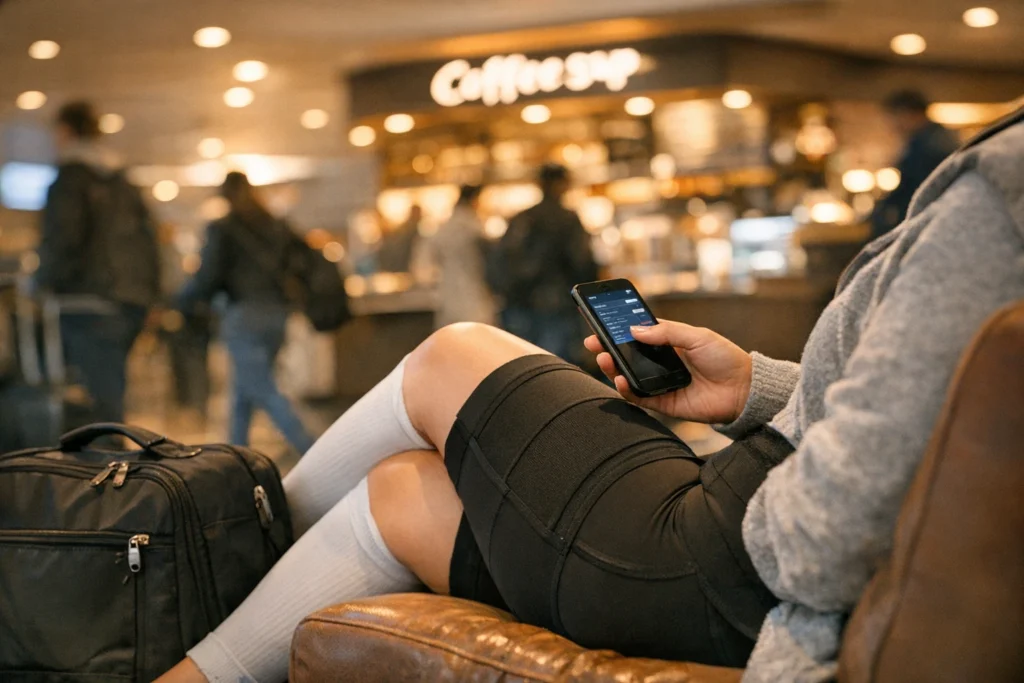
You have a flight booked. Maybe you went to Miami or flew to Colombia for the surgery and now you need to get home. Maybe you had lipo locally and Thanksgiving is in six weeks and your family is in another state. Either way, you are Googling “flying after liposuction” at some point, and you deserve an honest answer instead of the vague “check with your surgeon” non-answer that most articles offer.
There are actually two separate concerns here, and most patients blend them into one general worry. Keeping them distinct makes the whole picture clearer.
The DVT Risk: What It Is and Why Surgery Elevates It
Deep vein thrombosis, a blood clot forming in the deep veins, typically the legs, is a real risk after any surgical procedure. The reasons are not mysterious: surgery triggers an inflammatory and clotting response in the body, immobility reduces blood flow in the veins, and being stationary in an airplane seat for hours compounds both factors.
This is not a reason to panic. It is a reason to understand the mitigation. Compression garments, compression socks, staying hydrated, and getting up to move every hour on a long flight are the standard tools. They work. The risk is manageable, not unavoidable.
What makes the post-lipo window specifically higher risk is the combination of surgical inflammation, the disruption to the lymphatic system, and the fact that many patients are less mobile than usual in the early weeks. The clot risk is highest in the first two weeks. It is meaningfully lower by weeks six through eight, though not zero.
Timing: What Surgeons Typically Advise and Why It Varies
There is no single universal rule, and any article that gives you one is oversimplifying. Most surgeons advise a minimum of one to two weeks before flying after liposuction, and some extend that recommendation for longer flights or more extensive procedures like lipo 360. Body contouring that includes multiple areas, or lipo combined with a tummy tuck, typically comes with a longer wait. Your surgeon’s specific recommendation for your procedure and your health history is what matters, not a general guideline from the internet.
That said, the honest common pattern: one to two weeks for short domestic flights, two to four weeks for long haul international travel, and longer if your procedure was extensive. Medical tourism patients flying home from the Dominican Republic or Colombia on day three to five are in a different category, one that requires specific precautions discussed below.
The practical note on returning to work after liposuction covers the broader activity timeline if you are planning multiple schedule decisions at once.
What the Flight Actually Feels Like: The Part Nobody Talks About

The DVT conversation is well-documented. The physical experience of being in an airplane with a post-op abdomen is almost never discussed, and it should be.
Sitting upright in an economy seat for hours compresses the abdomen and promotes swelling in the treated areas. Your faja, which fits reasonably well when you are standing, will feel tighter at altitude. Cabin humidity is low, which contributes to overall dehydration. The middle seat situation is genuinely uncomfortable if you need to get up every hour to walk and the people beside you are asleep. The bathroom on an airplane is a small confined space that requires more physical maneuvering than you expect when your core is sore.
Patients consistently describe day three or four post-lipo as a peak swelling moment, and that is exactly when many medical tourism patients are boarding their return flight. It is not dangerous if managed correctly. But it is not comfortable, and knowing that in advance allows you to plan for it rather than panic mid-flight.
Compression on the Flight: What to Wear and Why the Faja Stays On
Your faja is your abdominal compression. It does not come off for the flight. Full stop. Some patients have asked whether they should remove it for comfort during the flight, and the answer is no: the faja’s entire job is providing the compression that reduces swelling, supports the treated tissue, and, on a flight, helps mitigate the DVT risk at the abdominal and hip level.
Compression socks go on top. Your faja handles your torso, the socks handle your calves and lower legs. Wear both. The combination is especially important on flights over two hours.
For circulation on the flight
Graduated compression socks are standard advice for post-surgical flying. Truform compression socks are the pair we recommend; put them on before boarding, not after.
The full faja sizing guide covering Stage 1 and Stage 2 garments will tell you which stage you should be in and what to look for in terms of fit, which matters more on a plane than at home where you can lie down.
A stage 1 faja is the garment you wake up in and live in for the early weeks. The Snatched Body stage 1 faja is the one we recommend; our sizing guide covers how it should fit.
Medical Tourism Patients: The Early-Flight Reality
A meaningful share of lipo patients in the US had their surgery in another country and are flying home sooner than most domestic surgeons would advise. This is a reality, not a scandal. Colombian and Dominican surgeons perform thousands of these procedures on American patients annually, and they are familiar with the travel-home timeline.
If you are flying home between days three and seven, the things that actually help: book an aisle seat in advance, non-negotiably. Get up and walk the aisle every 45-60 minutes. Wear your faja and compression socks for the entire flight. Carry your post-op supplies in your personal bag, not your checked luggage. Do not drink alcohol on the flight. Stay aggressively hydrated. And make sure you have a follow-up appointment booked with a provider at home who can assess you in the first week back.
The complete guide on how long to wear a faja after lipo is worth reading before travel so you understand the full garment schedule you are working within.
Swelling After Flying: What to Expect When You Land
Increased swelling in the 24 to 48 hours after flying is normal and expected. The combination of prolonged sitting, altitude pressure changes, low cabin humidity, and possible sodium from airplane food or snacks all contribute. Do not judge your results during this window. The swelling will settle back to your baseline over the next day or two if you elevate, stay hydrated, and get back into your compression routine.
Your post-flight carry-on should include: your faja (wearing it), compression socks, a reusable water bottle to fill after security, an abdominal binder or extra pad if your surgeon recommended it, any prescribed medications or arnica supplements, and a loose change of clothes for comfort at your destination. Tight jeans for the flight home from your surgery trip is one of the most common mistakes, and it is entirely preventable.
FAQ
Is it safe to fly two weeks after liposuction?
For most patients who had a relatively straightforward procedure, two weeks is within the range many surgeons consider acceptable for short to medium-length flights. Long haul travel may warrant waiting longer. Your surgeon’s specific guidance for your procedure and health history is the definitive answer, not a general timeline.
Do I have to wear my faja on the plane?
Yes. Your faja provides the compression that your post-op abdomen needs, and removing it for the flight would defeat the purpose during exactly the conditions, prolonged immobility and altitude pressure, where compression matters most. Wear it for the entire flight and add compression socks for your legs.
What should I watch for that would mean I should not fly yet?
Open wounds that have not closed, active drainage, fever, signs of infection (increased redness, heat, or purulent discharge at incisions), or leg pain or swelling that could indicate a developing clot are all reasons to contact your surgeon before boarding. These are the call-your-surgeon signals, not manageable-at-home situations.
This article is for educational purposes only and is not a substitute for professional medical advice. Always follow your injector’s or surgeon’s specific aftercare instructions.