
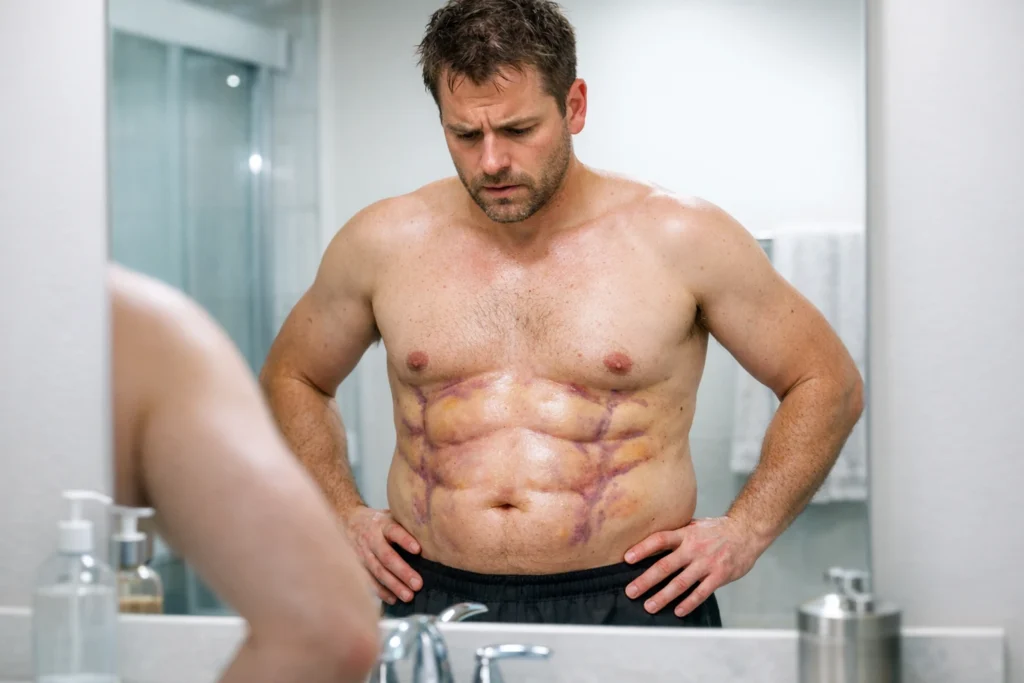
You get out of your compression garment for the first time since surgery, expecting some hint of the six-pack you paid for, and the mirror hands you back something puffy, uneven, and honestly a little concerning. This is ab etching recovery doing exactly what it’s supposed to do. The early weeks look worse, not better, and if nobody told you that going in, panic is the predictable result.
Ab etching, sometimes marketed as hi-def lipo, is judged in months, not days. The lines you paid for are hiding under swelling that takes a while to clear, and the single biggest factor in whether those lines eventually show up clean is something as unglamorous as how faithfully you wear a compression garment.
Want the short version? Jump to the FAQ.
Quick answer: Swelling and bruising peak in the first week, and it’s normal for the abdomen to look puffy, firm, or even lumpy for the first two weeks. Compression garments get worn nearly full time for about 3 to 6 weeks. Most normal activities resume around 2 weeks, but anything that contracts the core waits until your surgeon clears it. Early definition starts showing around 2 to 3 months, with final results commonly landing at 3 to 6 months, and results hold only if your weight stays stable.
The Looking-Worse Phase of Ab Etching Recovery
Swelling and bruising peak during the first week. That’s not a complication, that’s the surgery doing what surgery does. In weeks one and two, the abdomen commonly looks puffy, feels firm to the touch, and can even develop lumpy, uneven areas that seem to contradict everything the procedure promised.
In patient accounts, this early phase is consistently described as the single biggest panic point of the entire process. People who were told to expect definition end up staring at swelling instead, and start wondering if the surgeon missed the mark. Almost always, nothing was missed. The tissue just hasn’t finished settling yet.
Compression Is the Whole Ballgame
If there’s one variable that separates a clean result from a disappointing one, it’s compression discipline. The garment gets worn nearly full time for roughly 3 to 6 weeks, on whatever specific schedule your surgeon sets, not a generic countdown you found online.
Foam worn under the garment matters just as much as the garment itself. It keeps pressure even across the etched grooves specifically, rather than letting the compression flatten out and miss the detail work the surgeon did. A multi-pack of lipo foam sheets is the standard tool here. For the male torso specifically, a compression vest built for men’s chest and midsection is the general style to look for, rather than a garment designed around female anatomy. Our full comparison of abdominal boards versus lipo foam goes deeper into when each tool applies.
Skipping compression, or wearing it inconsistently because it’s uncomfortable, doesn’t just slow healing. It risks the actual definition you had surgery to get. This is not a step to shortcut.
The Activity Timeline
Light walking is fine from early on, and it actually helps circulation and swelling resolution. Most normal daily activities resume around 2 weeks for most patients.
Core-contracting exercise is a different story entirely. Crunches, planks, heavy lifts, anything that actively engages the treated muscles, stays off the table until your surgeon explicitly clears it, not when you personally feel ready. This overlaps heavily with general lipo activity guidance. If you’re a man researching this procedure, our broader look at male liposuction recovery covers how compression and training timelines differ from the standard content built around female patients. Our week-by-week guide to exercise after liposuction is worth reading in full before you touch a weight rack again.
When Definition Actually Shows Up
Early lines typically start emerging around 2 to 3 months, once enough swelling has resolved for the etched grooves to actually be visible under the skin. Final results commonly land somewhere in the 3 to 6 month range.
One detail gets left out of a lot of marketing: those results hold only with stable weight. Ab etching changes the shape of the muscle and fascia contours, it doesn’t grant permanent immunity to weight gain. Significant weight changes afterward can soften or obscure the definition you waited months to see.
It helps to know what you’re actually looking at during that first uncomfortable month. The puffiness isn’t fat that surgery failed to remove. It’s fluid and inflammatory response sitting on top of muscle and fascia work that’s already done. As your body reabsorbs that fluid over the following weeks, the etched contours underneath start to become visible on their own, without any additional intervention needed beyond patience and consistent compression.
Lymphatic Massage and Fibrosis
Lymphatic massage is frequently recommended specifically for this procedure, more so than for some other lipo work, because it helps move the swelling that’s obscuring your results along faster. Hard, uneven spots respond better to early attention than to being ignored and hoped away.
A massage roller designed for fibrosis and lymphatic work is a reasonable at-home supplement between professional sessions, or a lighter option if professional massage isn’t in the budget right now.
Normal vs. Not Normal
| Normal | Call Your Surgeon |
|---|---|
| Swelling and bruising, especially in week one | Sudden one-sided increase in swelling |
| Firmness across treated areas | Fever |
| Temporary lumpiness as tissue settles | Spreading redness |
| Tightness under the garment | Foul-smelling drainage |
| Gradual improvement week over week | Pain that worsens rather than improves after day 3 or 4 |
| Chest pain or shortness of breath: emergency care, any time |
Patience is the theme running through nearly every part of this recovery, and it’s worth saying plainly: the surgeon’s technical work was likely finished correctly weeks before you can actually see it reflected in the mirror. The lag between the procedure and the visible result is the part almost nobody explains clearly beforehand, and it’s the single biggest reason patients second-guess a result that was, in fact, going exactly to plan.
FAQ
Why does my abdomen look worse two weeks after ab etching?
Swelling and bruising peak early and can make the area look puffy, firm, or uneven, which is the opposite of the result you’re expecting. This is normal and temporary. The etched lines are hiding under fluid and inflammation that hasn’t resolved yet, not evidence that anything went wrong.
How long do I actually have to wear the compression garment?
Generally close to full time for about 3 to 6 weeks, following your surgeon’s specific schedule rather than a generic number. Consistency here directly affects how clean your final result looks.
When can I do crunches or ab workouts again?
Not until your surgeon explicitly clears core-contracting exercise. Most normal daily activities resume around 2 weeks, but crunches, planks, and heavy lifting are a separate, later clearance specific to the treated muscles.
This article is for educational purposes only and is not a substitute for professional medical advice. Always follow your injector’s or surgeon’s specific aftercare instructions.