
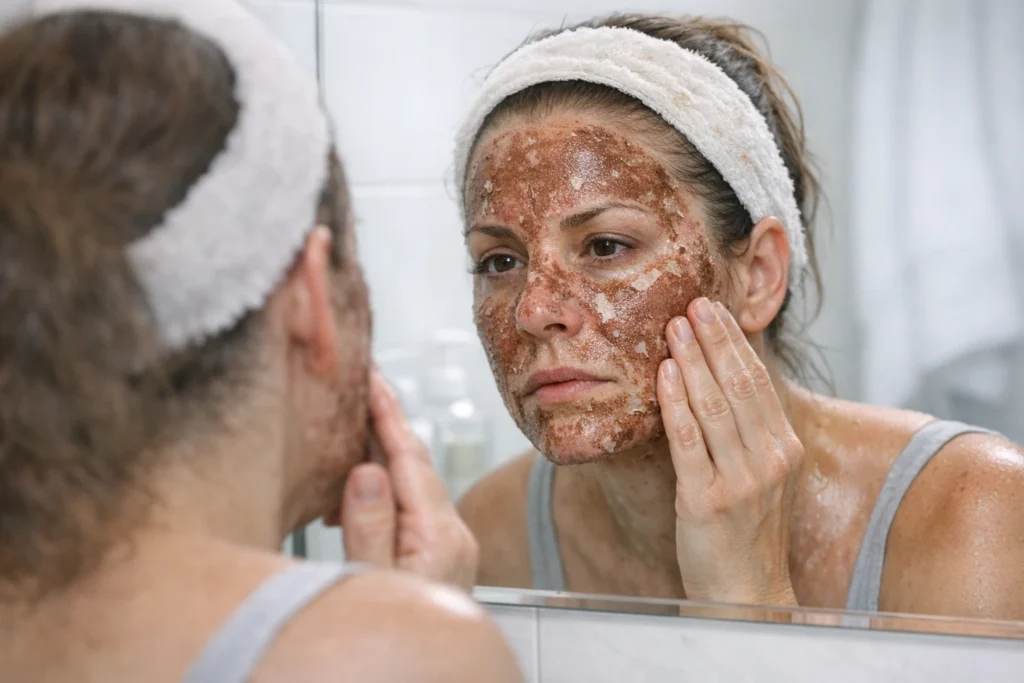
Day three. You are standing in the bathroom, looking at your face. The skin has darkened, roughened, and developed a texture that nobody described to you as skin. The consultation was about “skin rejuvenation” and “transformative results.” The photos you were shown were taken months after treatment. Nobody showed you a photo from day three. This is that photo.
Looking for a quick answer? Jump to the FAQ below.
The short answer
Days 0-2: redness, swelling, and possible weeping, all normal. Days 3-7: skin darkens, crusts, and peels in the most alarming visual phase. Day 7-8: mineral makeup clears. Day 14: cautious routine resumes. Months 2-3: full collagen results visible. Fractional CO2 means 5-7 days social downtime. Fully ablative means 10-14 days.
Fractional vs. Fully Ablative CO2: Two Very Different Recoveries
Before anything else: full ablative CO2 and fractional CO2 are not the same procedure and do not produce the same recovery.
Fully ablative CO2 removes the entire surface of the skin in the treated area. The result is an open wound that heals from scratch. Social downtime is 10-14 days minimum, and complete recovery takes 3-6 weeks. This is a significant procedure with significant recovery.
Fractional CO2 delivers energy in a pixelated pattern, treating columns of skin while leaving intact skin between them. The intact columns serve as healing depots that accelerate surface recovery. Social downtime is 5-7 days for moderate intensity fractional. Most clinics use fractional CO2 for full-face resurfacing in 2026 because it reduces downtime while still producing meaningful collagen remodeling. The rest of this article addresses fractional CO2 as the most common patient experience. If your provider used fully ablative CO2, the phases below apply but the timelines extend further.
CO2 laser recovery is more demanding than a medium-depth chemical peel recovery, with which patients sometimes compare it. Both involve skin shedding, but the depth and uniformity of the wound are different.
CO2 Laser Recovery Day by Day: What Is Actually Happening to Your Skin
| Timeframe | What to Expect |
|---|---|
| Day 0 | Red, hot, swollen. Ointment applied. Rest only. Head elevated. |
| Day 1 | Continued swelling. Begin gentle cleansing. Ointment frequently. No actives or makeup. |
| Day 2-3 | Swelling peaks. Possible weeping of clear fluid. Skin begins to bronze and crust. Do not pick. |
| Days 3-7 | Bronzed, rough, crusting texture. Most alarming phase. Keep moist with ointment. No picking. |
| Day 7-8 | Mineral makeup clears. Fresh pink skin visible under resolving crust. |
| Day 10-14 | Liquid foundation clears. Cautious skincare routine resumes. |
| Weeks 3-4 | Redness fading. Early texture improvement visible. Mineral SPF essential. |
| Months 2-3 | Full collagen remodeling results visible. Peak result at weeks 8-12. |
Day 0, treatment day: the skin appears red, hot, and swollen immediately after. Some pinpoint bleeding or oozing is possible. The provider applies protective ointment or a dressing. The first hours at home involve resting with the head elevated and not touching the treated area.
Day 1: the swelling often looks worse than day 0, particularly around the eyes for facial treatment. Begin gentle cleansing with a fragrance-free cleanser and lukewarm water twice daily. Reapply petroleum-based ointment or the provider’s recommended barrier product frequently. The skin should never feel dry or tight. Dryness slows healing. No makeup, no exfoliants, no active ingredients.
Day 2: swelling typically peaks between 24-72 hours. The skin may weep a clear or slightly yellowish fluid. This is serum. It is a normal part of wound healing and is not a sign of infection. The skin looks alarming at this stage. That is expected. The first 72 hours involve significant swelling, redness, and a burning or stinging sensation, often accompanied by this oozing.
Days 3-5: this is the phase that catches patients most off guard. The skin starts to dry, darken, and form a rough, bronzed, crusted texture as old damaged tissue sheds. Many patients describe this as the hardest visual stage. The crusts are the protective layer over new skin forming underneath. Do not pick them. Do not scrub. Removing crusts prematurely causes scarring. Continue applying ointment to keep the crust soft, which makes it more comfortable and supports the skin beneath.
Days 5-7: fresh pink skin begins to appear as crusts lift naturally. Many patients feel relief at this stage as the surface looks cleaner. Still very sensitive. No sun exposure.
Day 7-8: mineral-based makeup typically clears at this point once the skin is no longer weeping or actively crusting. Standard liquid foundation and concealer wait until day 10-14.
Day 14: most patients can resume a careful skincare routine. The skin is still pink and sensitive. Mineral SPF every day without exception.
Wound Care: The One Thing That Determines How This Goes
The first priority throughout the healing phase is keeping the skin clean and moist without disturbing the healing process. Fragrance-free gentle cleanser twice daily. Petroleum-based ointment or the provider’s recommended barrier product applied frequently, keeping the skin consistently moist throughout the day. For the first 48 hours, petroleum-based ointments, bio-occlusive films, or hydrogels are the recommended approach to reduce crust formation and support healing.
No retinoids, no acids, no vitamin C, no exfoliants until the provider explicitly clears them. This is not the time to ask when vitamin C and other actives can safely return: wait until your provider confirms the skin is healed enough to tolerate active ingredients, which is generally not before week 2-4 depending on the treatment intensity.
Exercise during recovery: light walking is generally fine from day 3 or 4. Avoid strenuous exercise, hot yoga, saunas, or any activity that significantly raises body temperature or induces heavy sweating for at least 10-14 days. Heat and sweat introduce infection risk and can worsen swelling.
Two Risks Your Consultation Should Have Covered
The cold sore risk is real and frequently skipped at consultation. CO2 laser treatment can trigger herpes simplex reactivation in patients who have had cold sores. Many providers prescribe prophylactic antiviral medication before treatment for any patient with a cold sore history. If this was not discussed and you have had cold sores, raise it before treatment. Cold sore blisters appearing near the mouth within 48 hours of treatment require immediate contact with your provider.
Skin tone matters significantly. Post-inflammatory hyperpigmentation rates of 30-68% have been documented in Fitzpatrick IV-VI skin types undergoing CO2 laser resurfacing without appropriate protocols including prophylactic bleaching agents and strict UV avoidance. This does not mean CO2 laser is off-limits for darker skin. It means the consultation, pre-treatment protocol, and post-treatment care plan must specifically address PIH prevention. If a provider does not raise this topic for a patient with Fitzpatrick III+ skin, that is an incomplete consultation. The comparison here is to microneedling aftercare, where the wound-healing process is similar but the depth and PIH risk are substantially lower.
When You Will Actually See the Result
Initial texture improvements are visible once redness fades at weeks 3-4. The full benefit, including the deep collagen remodeling that is the primary reason patients choose CO2 over less intensive options, develops over 3 months. Most patients see their best result at 8-12 weeks. Redness in laser-treated areas typically fades within 2-3 months but may take up to 6 months in some patients.
CO2 laser can produce 50-80% improvement in primary skin concerns after a single treatment. That range is wide because results depend significantly on skin type, treatment settings, aftercare quality, and the specific concern being treated.
Clinics that describe CO2 laser as a “lunch hour treatment” or show only month-three results without week-one reality are creating patients who are unprepared for what they signed up for. The treatment is worth it for the right candidate. The recovery is genuinely demanding. Both things are true and patients deserve to know both. The patients who found an honest description of each day and experienced it as “exactly what I expected” had the same recovery as the patients who described days 3-5 as a crisis. The difference was information.
This is normal and expected
- Skin appearing significantly worse on days 3-5 than day 0
- Weeping of clear or pale yellowish fluid in days 1-3
- A bronzed, darkened, crusting texture on days 3-7
- Pink to red skin colour persisting for weeks to months
- Tightness and sensitivity when applying any product
Call your provider if
- Green or yellowish cloudy drainage with odour (different from clear serum, this is infection)
- Increasing pain, heat, and redness at day 2 rather than plateauing
- Fever following treatment
- Crusting spreading significantly beyond the treated area
- Cold sore blisters appearing near the mouth within 48 hours of treatment
Frequently Asked Questions
How long is CO2 laser social downtime?
For moderate intensity fractional CO2, most patients return to work with makeup coverage at days 7-8 (mineral makeup) or day 10-14 (full foundation). Social comfort without coverage typically takes 3-4 weeks as residual redness fades. Fully ablative CO2 requires 10-14 days of social downtime minimum and 3-6 weeks for complete recovery. Know which type of treatment you are having before you plan your schedule.
What does normal healing look like after CO2 laser?
Day 0-2 involves redness, swelling, and possible clear fluid weeping. Days 3-7 involve the skin darkening, bronzing, and crusting as old tissue sheds. Day 7-8 onwards, fresh pink skin appears under resolving crusts. Weeks 3-4, redness fades and texture improvement becomes visible. Full collagen results at months 2-3. Anything that deviates significantly from this progression, particularly worsening pain or odorous discharge, warrants contacting your provider.
When can I use my normal skincare after CO2 laser?
Most providers clear patients for a gentle return to normal skincare at day 14, with full routine (including actives like retinoids, vitamin C, and acids) cleared at weeks 3-4 depending on how the skin has healed. The timeline varies by individual healing and treatment intensity. Do not introduce actives without specific clearance from your provider. Mineral SPF is non-negotiable from day 7-8 onwards and must be applied daily for at least 3-6 months while pigmentation risk remains elevated.
This article is for educational purposes only and is not a substitute for professional medical advice. Always follow your injector’s or surgeon’s specific aftercare instructions.