
You just had a procedure. Maybe microneedling, maybe filler, maybe botox. You are looking at your skincare shelf wondering what you can actually use right now. Niacinamide is in at least three of your products. Your injector said to avoid actives, but niacinamide doesn’t feel like an active the way retinol does. Is it fine?
The answer depends on which procedure you just had, and it is simpler than most post-procedure skincare advice suggests.
Looking for a quick answer? Jump to the FAQ below.
The short answer
After microneedling: wait 72 hours, then start with a 2-5% formula when skin is calm. After lip filler or botox: fine to continue after the first 24 hours, there is no significant skin barrier change from these procedures. After deeper procedures: wait until the skin has re-epithelialized (5-10 days) then reintroduce niacinamide before stronger actives.
What Niacinamide Actually Does and Why Timing Matters
Niacinamide is a water-soluble form of vitamin B3. In skin it reduces inflammation, supports the barrier by stimulating ceramide production, regulates sebum, reduces the appearance of pores, and helps with post-inflammatory hyperpigmentation. These properties are genuinely suited to recovery skin. The anti-inflammatory and barrier-supporting action is exactly what healing skin needs.
The timing question exists because the delivery mechanism matters as much as the ingredient itself. When the skin barrier is compromised, anything applied absorbs more deeply and at higher concentrations than it does through intact skin. That is true of irritating ingredients like retinol, but it is also true of beneficial ones like niacinamide at high concentrations. The difference is that niacinamide handles this well at the right concentration, where retinol does not.
Niacinamide After Microneedling: The 72-Hour Rule
The micro-channels created by microneedling remain highly permeable for approximately 6-8 hours post-treatment. Skin remains more absorbent than normal for the full 72 hours. This is why the first 24 hours after microneedling have specific ingredient restrictions: what you apply goes deeper and at higher concentrations than normal.
Even though niacinamide is gentle, applying it during this window means concentrations reaching the dermis that it wasn’t formulated for. Most clinicians advise waiting at least 72 hours before reintroducing niacinamide after microneedling.
The practical approach: nothing beyond your provider’s recommended products for the first 24 hours. Then a gentle fragrance-free moisturiser. Then introduce niacinamide at 2-5% concentration from day 3 when redness has settled and skin is calm. Higher concentrations (10%+) should wait until the skin is fully healed. This is also the window when copper peptides become a well-suited supportive ingredient alongside niacinamide during recovery.
Niacinamide After Botox and Lip Filler: Mostly Not an Issue
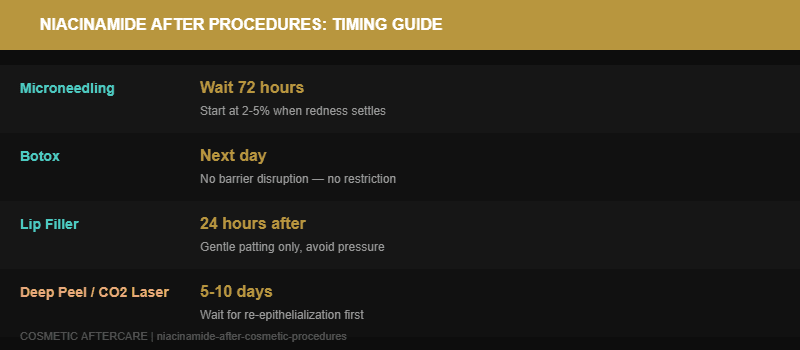
Botox and lip filler do not disrupt the skin barrier in the way microneedling does. Botox works beneath the skin via injection and the surface remains essentially intact. Lip filler similarly involves injection rather than surface disruption. The skin barrier function is unchanged by both procedures.
After lip filler, niacinamide applied near the injection site is not a concern after the first 24 hours. The caution with topicals after lip filler is primarily about pressure and manipulation of the treated area in the days immediately following, not about ingredient penetration. A serum applied by gentle patting is not the same as massaging or pressing the tissue.
After botox, niacinamide can continue the day after treatment without restriction. The instructions many injectors give to “avoid actives” after botox apply to the first 24 hours specifically, and relate to physical pressure on the injection sites rather than ingredient safety concerns. Patients who extend that moratorium to two weeks, which is a common misreading of the instruction, are keeping their skin from support it would benefit from.
Niacinamide After Deeper Procedures
After deep chemical peels or laser resurfacing where the skin surface is significantly disrupted, niacinamide waits until re-epithelialization: typically 5-10 days depending on treatment depth. Once the barrier is intact, niacinamide at 2-5% is an excellent early reintroduction choice for barrier repair before returning to stronger actives.
The sequence matters. Niacinamide first. Then, once the barrier has been supported for a week or two, retinol restart timing becomes the conversation. Niacinamide is the right first active to reintroduce after most procedures because its mechanism is supportive rather than disruptive. Retinol, vitamin C at active concentrations, and AHAs or BHAs all require a more intact barrier than niacinamide does.
Why Niacinamide Is the First Active Back, Not the Last
Retinol accelerates cell turnover, which is exactly what healing skin doesn’t need. Vitamin C at effective concentrations can sting on a compromised barrier. AHAs and BHAs are exfoliants that should stay away from healing skin entirely. Niacinamide’s anti-inflammatory and barrier-building mechanism is additive to the recovery process rather than potentially disruptive of it.
The overcaution pattern looks like this: a patient has botox, is told to avoid actives for 24 hours, reads online that “no actives for two weeks” is the safe approach, and spends two weeks with a stripped-down routine when a targeted niacinamide serum from day two would have actively supported their skin. The two-week moratorium after minor injectables is overcaution that compounds into worse skin outcomes during the recovery window.
The evidence that niacinamide belongs in post-procedure routines appears in practice: dermatologist-recommended post-procedure sunscreens often combine zinc oxide with niacinamide specifically because the combination calms and supports sensitive, post-procedure skin. The ingredient’s presence in these formulations is not incidental.
Niacinamide is appropriate when
- It is 72+ hours after microneedling and redness has settled
- The day after botox or filler (no barrier disruption occurred)
- You are in the barrier repair phase after any procedure, before returning to retinol or acids
- Your skin feels sensitive but intact, not raw or actively reactive
Wait longer if
- You are within 72 hours of microneedling or any procedure that broke the skin barrier
- Your skin is still visibly reactive, weeping, or blistered
- You are in the first 5-10 days after a deep chemical peel or CO2 laser where significant surface disruption occurred
- Niacinamide is stinging or burning on application — this signals the barrier is not yet ready
FAQ
Can niacinamide cause a reaction on post-procedure skin?
At appropriate timing and concentration, niacinamide rarely causes reactions on healing skin. If niacinamide stings or burns on application after a procedure, this is a reliable signal that the skin barrier is not ready yet, not a sign that niacinamide is the wrong ingredient for recovery. Wait another 24-48 hours and try again. Stinging that persists may indicate the concentration is too high for the current state of the skin, so dropping to a 2% formulation is preferable to abandoning the ingredient entirely.
Is niacinamide the same as vitamin B3?
Niacinamide is one form of vitamin B3. The other main form is niacin, which is different in its effects on the skin and is not what appears in skincare formulations. Niacinamide is the water-soluble, skin-compatible form. It does not cause the flushing associated with niacin supplementation and is appropriate for topical use including on sensitive and post-procedure skin.
Can I use niacinamide with vitamin C after a procedure?
After a procedure, the order is: niacinamide first, vitamin C later. Niacinamide at 2-5% is appropriate from day 3 after microneedling or once re-epithelialization is complete after deeper procedures. Vitamin C in effective forms (L-ascorbic acid at 10-20%) should wait until the barrier is fully restored, as it can cause stinging on compromised skin and the acidic pH can interfere with barrier repair. The old concern that niacinamide and vitamin C interact negatively to create niacin has been largely debunked, but timing them separately is still a reasonable approach post-procedure.
Niacinamide is one component of a broader post-procedure skincare approach. The full guide to barrier-supportive ingredients after cosmetic procedures covers the complete ingredient framework, including what to use first and the reintroduction sequence that makes the most clinical sense.
This article is for educational purposes only and is not a substitute for professional medical advice. Always follow your injector’s or surgeon’s specific aftercare instructions.