
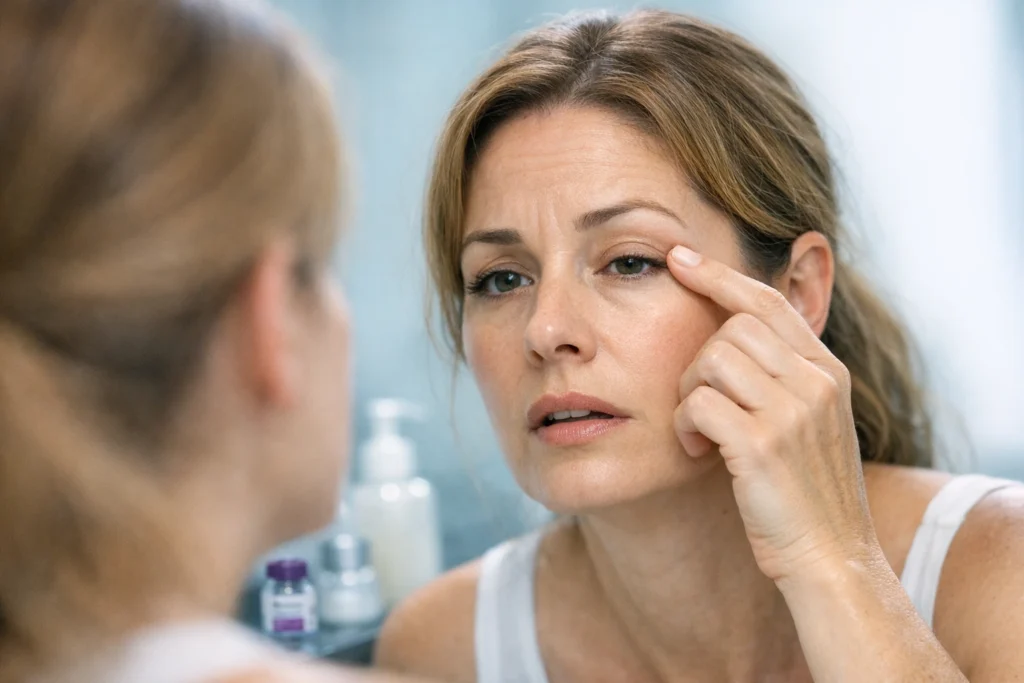
It is day four or five after your appointment, and something is off. One eye looks right. The other eyelid is sitting lower than it should, giving your face an asymmetry you did not go in for. You are not imagining it. This is botox ptosis, and the most important thing to understand in this moment is that it will resolve.
That said, “it will resolve” is not a complete answer. You want to know why it happened, how long you are looking at, and what, if anything, can be done while you wait. Those are reasonable questions, and they have real answers.
What Actually Happened
The muscle responsible for lifting your upper eyelid is called the levator palpebrae superioris. When Botox is injected into the forehead or glabellar region (the space between the brows), the toxin can diffuse slightly beyond the intended target and partially affect this muscle. The levator was not supposed to receive any of the dose. It received some. The result is a lid that cannot lift as fully as the other side.
This is not a sign that the injection hit a nerve permanently. Botox works by temporarily blocking acetylcholine at the neuromuscular junction. As the toxin is metabolised, the nerve-muscle connection restores itself. The levator is not damaged. It is temporarily quieted. The distinction between temporary inhibition and permanent damage matters, and patients who understand this tend to have a calmer relationship with the recovery period.
The mechanism of diffusion is the most common explanation for ptosis, though placement errors also contribute. Injections placed too close to the orbital rim, or in certain anatomical regions at too high a dose, carry a higher risk of toxin migration. If you have had Botox that did not work as expected, ptosis sits at the opposite end of that spectrum: too much effect in the wrong place.
How Common Botox Ptosis Actually Is
The occurrence rate across the literature sits at approximately 2 to 5%. Among experienced injectors, the rate falls below 1%. Among less experienced injectors focusing on glabellar and brow areas, it can reach 5.4%. That spread is not incidental. It tells you something worth knowing before you choose a provider: technique, placement, and dose management are the primary variables that determine whether ptosis occurs.
If this has happened to you, you are not in some extremely rare category. You are in a known, documented complication with a well-understood resolution path. And if you are now choosing a new provider for the next appointment, the rate gap between experienced and inexperienced injectors is a concrete, practical reason to be selective.
The Timeline: What to Expect and When
Ptosis typically becomes noticeable between two and ten days after treatment, once the toxin has fully bound. If you are at day fourteen and your eyelid position has not changed, further drooping is very unlikely. The toxin is not going to keep travelling at that point.
Most cases resolve in four to six weeks. This is significantly shorter than the full Botox treatment duration of three to four months. The reason is straightforward: the levator palpebrae superioris received a smaller amount of toxin than the target muscle did. It recovers faster. The muscle that was actually treated holds the effect longer.
Week one to two is usually the most visible phase. The asymmetry tends to be most apparent early, when the affected muscle is at its most inhibited. As the weeks progress, most patients notice gradual improvement, though the pace varies. For information on how toxin metabolism affects the overall timeline of your treatment, understanding how long Botox lasts provides useful context about what is happening as recovery progresses.
What Can Help While You Wait
There is one pharmacological option worth knowing about. Apraclonidine and oxymetazoline are alpha-adrenergic agonists used in eye drops. They stimulate Muller’s muscle, an accessory eyelid elevator that works alongside the levator palpebrae superioris. When Muller’s muscle is stimulated, it can temporarily lift the drooped eyelid by approximately 1 to 2mm. The effect lasts for a few hours and requires repeated use throughout the day.
These drops are prescription or pharmacist-dispensed products in most markets, not over-the-counter options you can simply pick up. Some patients discuss this option with their provider or dermatologist during the recovery period. The takeaway here is not “go find these drops yourself” but rather: there is a temporary, provider-supervised option available if you want to explore it.
For comfort, if the affected eye is not closing fully or is experiencing dryness, preservative-free artificial tears are a reasonable over-the-counter option. Complete or near-complete inability to close the eye is worth reporting to your provider immediately, as it has implications for corneal health.
What does not help: rubbing the area, applying heat, or trying to exercise the lid. These are intuitive impulses but they are not going to accelerate the toxin metabolism. It is also worth reviewing the post-treatment period instructions to understand what could contribute to further migration risk if ptosis is still in its early phase.
What to Tell Your Injector Next Time
Patients who experience ptosis and say nothing to their injector are the ones most likely to experience it again. The injector cannot adjust their technique for a complication they do not know about. This is not about blame. It is about practical information that changes what happens at the next appointment.
The adjustments that reduce ptosis risk in future sessions include: avoiding placement points too close to the orbital rim, keeping doses conservative particularly in the glabellar region, and being cautious about treating both the forehead and the glabella in the same session at high cumulative doses. If your injector is not asking about your last result at the beginning of the consultation, volunteer the information.
Some providers will offer a touch-up or adjustment at no charge when ptosis occurs, particularly in private practice settings. Whether or not that is offered, the documentation of exactly what was injected, where, and at what dose is the information that makes the next appointment different from this one.
When to Call Your Injector Sooner Rather Than Later
Most ptosis cases do not require urgent attention. But there are specific situations where calling your provider promptly is the right call. Any changes to vision, including blurring, double vision, or difficulty focusing, warrant a same-day call rather than watchful waiting. Difficulty closing the eye fully, particularly if sleeping is affected, should also be reported without delay. Ptosis that is actively worsening beyond the fourteen-day mark, rather than stable or improving, is a reason to check in.
Ptosis that is bilateral, meaning affecting both eyelids, or that is accompanied by any systemic symptoms, is outside the scope of routine post-Botox management and should be evaluated by a medical provider promptly.
Frequently Asked Questions
How long does botox ptosis last?
Most cases resolve in four to six weeks, which is considerably shorter than the full Botox duration of three to four months. The levator palpebrae superioris received a lower dose than the target muscle, so it recovers faster. In some cases resolution happens faster, in rare cases it takes closer to the full Botox duration. If your eyelid position has not improved at all by six weeks, a conversation with a dermatologist or oculoplastic specialist is worth having.
Can you prevent botox ptosis from happening again?
Yes, with technique adjustment. The main risk factors are injection points placed too close to the orbital rim, high doses in the glabellar region, and treating forehead and glabella in the same session at high cumulative volumes. Choosing an experienced injector with low complication rates, and explicitly telling them what happened at the previous appointment, are the two most practical steps you can take. Experienced injectors have significantly lower ptosis rates, and the rate difference between experienced and inexperienced practitioners is documented and substantial.
Should I be worried if the drooping gets worse in the first week?
Some worsening in the first five to seven days is within the expected pattern, as the toxin continues to bind during this window. Ptosis that becomes noticeable at day three may appear slightly more pronounced by day seven before it begins to improve. If you are past day fourteen and the position is still worsening, that is the point to contact your provider. Vision changes or difficulty closing the eye at any point warrant immediate contact.
If you are considering a more permanent correction for drooping eyelids, blepharoplasty is a surgical procedure with a different recovery profile and a week-by-week timeline worth understanding before committing.
Eyelid ptosis is one specific consequence of Botox diffusing where it should not. For the broader picture of how the toxin can move into adjacent muscles and what each scenario looks like by injection area, the Botox spreading guide covers local diffusion from forehead, glabellar, masseter, and perioral injections, as well as how to distinguish local diffusion from the rare systemic effects that require emergency rather than injector follow-up.
This article is for educational purposes only and is not a substitute for professional medical advice. Always follow your injector’s or surgeon’s specific aftercare instructions.