
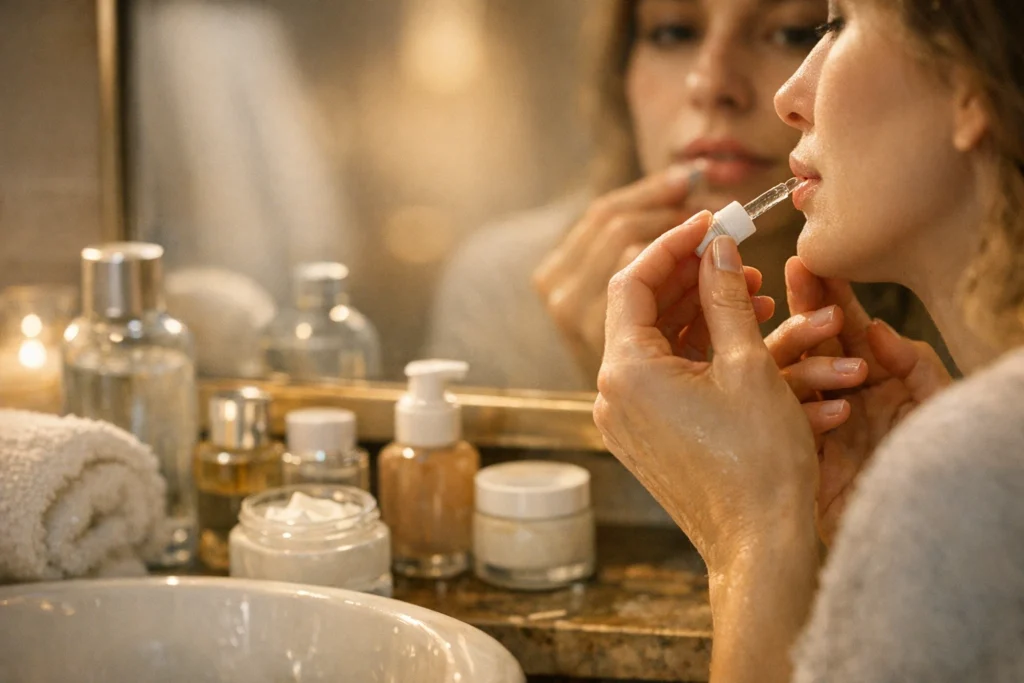
Almost all pre-filler advice covers the 24 hours before your appointment. Stop taking blood thinners. Skip the wine. Stay out of the sun. These are useful instructions, but they treat the preparation window as if it starts the morning before you come in. The thirty days before your appointment are the part of the timeline nobody talks about, and that window matters more than most patients are told.
The condition of your skin at the time of injection affects how the filler integrates, how the healing progresses, and how the result looks and lasts. Skin prep before lip filler is not a marketing category. It is a practical question about arriving with a skin environment that supports the best possible outcome from the procedure you have already booked.
Hydration and How Hyaluronic Acid Filler Actually Works
Hyaluronic acid filler does not sit in the tissue as an inert substance. It is hygroscopic: it attracts and binds water from the surrounding tissue. Well-hydrated skin provides a better medium for this process and can support more natural-looking results with better integration of the filler into the tissue structure. Dry, dehydrated tissue is a less hospitable environment.
The practical implication is straightforward. Consistent daily moisturisation in the two to four weeks before your appointment is worth more than the “heavy moisturiser the night before” advice most people receive. A hyaluronic acid serum in your daily routine during this window is supported by the mechanism: you are providing the surrounding tissue with the same substance the filler uses to attract and retain water. For context on how this works after the procedure, the rationale behind using hyaluronic acid serum after lip filler rests on the same mechanism.
Systemic hydration matters too. The skin is not in isolation from overall fluid balance. Consistently well-hydrated tissue responds differently to injection trauma than chronically dehydrated tissue does. This is not a new recommendation, but it is one that patients often hear only in the context of bruising reduction rather than filler integration.
Barrier Health: The Variable That Gets Ignored
Skin barrier function is the most underappreciated factor in pre-filler preparation. Compromised barrier skin, from over-exfoliation, strong retinoids, or sensitising actives, responds more intensely to any injection trauma. The inflammatory response to a needle puncture is partly modulated by how reactive the local skin environment is at the time.
The pattern that shows up consistently in patient accounts: those who arrive with dry, reactive, or sensitised skin from aggressive skincare routines have more intense swelling and slower resolution. The preparation that matters most here is restraint, not addition. Stripping back your routine in the one to two weeks before the appointment gives the barrier time to recover.
Stop retinoids five to seven days before the appointment. This is not because retinol causes problems with the filler itself. It is because retinoids accelerate cell turnover and can sensitise and thin the skin surface, and compromised barrier skin responds more intensely to any injection trauma. For a full explanation of retinoid timing around cosmetic procedures, the guidance on retinol use around cosmetic procedures covers both the before and after picture in detail.
Exfoliating acids should stop three to five days before the appointment. Again, the same principle: if these products are actively accelerating cell turnover or creating any sensitivity, they are counterproductive in the final approach to injection day. The goal is arriving with a calm, intact barrier, not a skin surface that has been aggressively optimised in the 72 hours prior.
Vitamin C and Collagen Support
Vitamin C is essential for collagen synthesis. Without adequate vitamin C, collagen production is impaired. This is established biochemistry. A regular vitamin C serum used in the weeks before lip filler is mechanistically sound: you are supporting the structural integrity of the tissue that the filler will integrate with.
Where to be honest about the limits of the evidence: there is no clinical trial showing that pre-loading vitamin C produces measurably better lip filler results. The mechanism is real. The specific outcome data is not there. Stating this distinction matters because the space is full of claims that treat mechanistic support as equivalent to clinical proof. If you already use a vitamin C serum daily, continue it through the prep window. If you do not, adding one during this period is a low-downside, mechanistically supported choice. It is not a guarantee of anything.
Sun Protection as a Structural Recommendation
UV damage does not just create visible surface changes. It degrades collagen, thins the skin, and compromises the structural integrity of the tissue. SPF use in the month before lip filler is not a vanity recommendation. It is a structural one. Skin in good UV condition, with intact collagen and better tissue integrity, provides a more supportive environment for filler and is associated with better longevity of results.
Most patients already know they should wear SPF. The pre-filler context is simply a concrete reason to be consistent about it rather than occasional. If you are only applying SPF when you remember, the 30-day window before a filler appointment is a good time to build consistency. The investment is cumulative in both directions: consistent protection maintains the tissue quality that supports better filler outcomes, and inconsistent sun exposure during this period works against it.
The Final Week: What to Stop and Why
The final week before the appointment is about minimising anything that might create additional sensitivity or barrier disruption. Retinoids should already be stopped (day five to seven before). Exfoliating acids stop three to five days before. Anything that is currently causing active redness, sensitivity, or peeling should stop immediately.
New products should not be introduced in the final week. Introducing a new active, even a well-reviewed one, creates an unknown variable in how your skin will behave at the appointment. Reactions to new ingredients can take several days to appear. The final week is not the time to experiment.
For the full pre-appointment checklist including supplements, medications, and other factors to avoid in the run-up to your procedure, what to avoid before lip filler covers the complete picture. The skin prep questions overlap with but are distinct from the safety considerations in that list.
The Honest Position on Pre-Filler Kits
Most “pre-filler prep kits” sold by clinics or beauty retailers are overpriced collections of basic products the patient may already own. There is nothing magical about a kit that has been assembled and branded specifically for pre-procedure use. The preparation is a routine, not a product set.
A good moisturiser, an SPF used consistently, a vitamin C serum, and a hyaluronic acid serum, all used regularly for 30 days before the appointment, will do more than any specially branded pre-treatment kit at three times the cost. The ingredients doing the work are commodity items available from dozens of brands at a wide range of price points. Do not pay a premium for curation when the curation is straightforward.
Frequently Asked Questions
How long before lip filler should I start prepping my skin?
The useful window is 30 days. The first two to four weeks are for building habits: consistent hydration, daily moisturiser, SPF, and vitamin C serum. The final week is for simplification: stopping retinoids and exfoliating acids and giving the skin barrier a chance to be calm and intact at the time of injection. Starting closer to the appointment, or only in the 24 hours before, captures very little of the benefit.
Does skin condition actually affect how long lip filler lasts?
Yes, though the evidence is mostly mechanistic rather than directly measured. HA filler attracts water from surrounding tissue. Dehydrated tissue with compromised barrier function provides a less supportive integration environment. UV-damaged skin has degraded collagen structure, which affects tissue quality. Better maintained skin is generally associated with better filler longevity, though this is one of multiple variables. Good technique and appropriate product selection are also significant.
Is it worth stopping retinol if I’ve been using it for years?
Yes, for the five to seven days before the appointment. Long-term retinol users have well-adapted skin, but the issue is not tolerance to retinol as a routine ingredient. The issue is that retinoids accelerate cell turnover and can compromise barrier integrity in the final days before an injection procedure. A brief pause does not meaningfully set back your long-term skin progress. Resume it, as your provider advises, once healing is underway.
This article is for educational purposes only and is not a substitute for professional medical advice. Always follow your injector’s or surgeon’s specific aftercare instructions.