
Every clinic website says the same thing: three to four months. Ask your injector and you will probably hear three to four months. It is not wrong exactly, but it is the starting point of the real answer, not the whole answer. Whether your botox lasts ten weeks or six months comes down to four variables, and not one of them can be fully predicted at your first appointment. Understanding them at least tells you why your friend’s forehead botox is still going strong at month five while yours has softened at eleven weeks. Neuromodulator injections like Botox remain the most performed minimally invasive treatment in the country, with roughly 9.9 million procedures in 2024, up 4 percent year over year, according to the American Society of Plastic Surgeons’ 2024 Plastic Surgery Statistics Report. How well you follow the botox aftercare rules in the first 24 hours is one factor that influences how cleanly the product binds.
Why Different Areas Metabolize at Different Rates
Botox works by temporarily blocking the nerve signal that tells a muscle to contract. The treatment duration has a direct relationship with the size of the muscle being treated and how frequently it moves. This is the most underexplained part of the longevity conversation, and it matters enormously when you are trying to set realistic expectations.
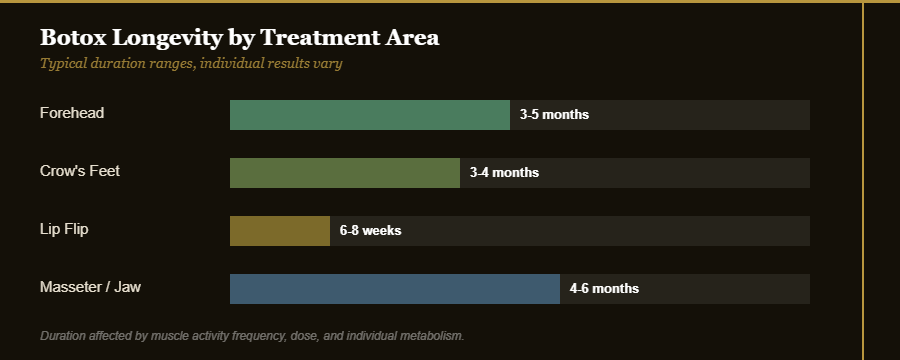
The forehead is a large, relatively slow-moving muscle. It does not contract constantly the way smaller, more active muscles do. This is why forehead botox tends to last toward the longer end of the range for most patients. Crow’s feet muscles are smaller but move frequently, every time you smile, squint, or laugh, which typically puts their duration at three to four months in most people. The lip flip is a different story entirely: the orbicularis oris muscle around the mouth is one of the most active muscles in the face, contracting hundreds of times a day with speaking, eating, and expression. Many patients find lip flip results wear off in six to eight weeks rather than the standard range. This is not a complication or a sign something went wrong. It is biology.
Masseter injections for jaw slimming use more product, in a larger muscle, and often last four to six months or longer. Neck band (platysmal band) treatments tend to fall somewhere in the middle.
Your Metabolism: The Variable Nobody Can Predict
Some people metabolize botox faster than others, and there is no reliable way to know which category you fall into before your first appointment. High-intensity exercise increases metabolic rate overall, which some patients anecdotally associate with faster botox breakdown, though the science on this is not settled. Being very physically active, running a high caloric burn lifestyle, and having an overall faster metabolism may mean your results wear off closer to the two-to-three month mark while someone more sedentary sees five months or more.
The frustrating truth is that appointment one is partly a diagnostic. Your body will tell you what your personal timeline looks like. By appointment two, your injector should have a much clearer picture of your metabolism speed, and can adjust timing and dose accordingly.
The Dose Question (Have This Conversation with Your Injector)
Higher doses within clinically appropriate ranges generally produce longer duration. More product in the muscle means a more complete block, and the gradual return of movement takes longer. This is not an invitation to request the maximum possible dose at every appointment. The right dose depends on the area, the desired effect (a frozen look versus a softened-movement look), and your anatomy. It is a nuanced clinical decision.
What it means practically: if your results are consistently on the shorter end and you want more duration, this is worth raising explicitly with your injector as a goal. “I want to prioritize longevity over complete immobility” is a useful frame for that conversation.
What nobody should be giving you is specific unit counts or dosing guidance in an article. That conversation belongs with the person looking at your face.
What “Wearing Off” Actually Feels Like
Patients often describe expecting botox to wear off suddenly, like a light switch. It does not work that way. The return of movement is gradual. Most people first notice a slight softening in expression that they can feel but that is not obvious to anyone else. Then movement returns in small increments over two to four weeks until the muscle is fully mobile again.
Patients consistently describe a moment around week ten or twelve when they suddenly notice they can raise an eyebrow more than a week ago. That observation is usually the beginning of the wear-off window, not the end. By week fourteen or sixteen, depending on the person, movement has usually returned fully.
Before you return to the aftercare guidance that applies immediately after your appointment, the first 24 hours of botox aftercare covers the most important protective window after your injection, which can also affect how well the treatment takes initially.
Repeat Patients Often See Longer Duration Over Time
This is one of the more clinically interesting aspects of botox longevity, and it is rarely explained at consultations. Muscles that are repeatedly treated tend to become less active over time. The fibers atrophy slightly from reduced use, and the muscle overall requires less product to achieve the same effect. Many patients who have been treating the same area for two or three years find their results lasting noticeably longer per treatment than they did at the start.
The mechanism is not mysterious: a muscle that has been resting for three to four months, multiple times over several years, changes. This is actually an argument for staying on a consistent treatment schedule rather than going in and out based on cost or convenience. Irregular treatment lets the muscle fully recover its full activity pattern each time, which can reset the timeline.
The “Should I Top Up Before It Wears Off” Question
There is genuine disagreement among injectors on this. One school of thought holds that topping up when you are at around 50 to 70 percent wear-off, rather than waiting for full return of movement, keeps the muscle in a more consistently rested state and can extend overall longevity over time. The other school argues for waiting until movement has substantially returned before retreating, to avoid over-accumulation of product and to allow the muscle a brief full-function period.
Both approaches have clinical logic. The right answer depends on your goals, your rate of wear-off, and your injector’s philosophy. What it should not be is a sales tactic from a clinic pushing you to book before you are ready. If your result still looks and feels good, you are not behind.
For activity-related timing around your injections, the working out after botox guide covers what the movement and heat restrictions are in the first 24 hours and why they matter for result quality.
If Your Result Barely Lasted Six Weeks
This is a different conversation than normal metabolism variation. If your botox result appeared incomplete from the first week, or seemed to wear off in under eight weeks with no visible improvement during that window, those are signals worth investigating, and the breakdown of botox not working as expected covers the most common reasons by area. Possible factors include underdosing, technique issues, product storage problems, or in rare cases, antibody resistance that some repeat patients develop over years of treatment. These situations are worth diagnosing, not accepting as your personal normal.
Frequently Asked Questions
Why did my crow’s feet botox wear off faster than my forehead botox?
This is completely normal and expected. The muscles around the eyes are smaller and move constantly, every expression, every blink, every smile. More frequent muscle use means the nerve signal block is challenged more often and wears off faster. Your forehead muscle moves comparatively less, so the effect holds longer. These areas will almost always have different timelines for the same patient.
I exercise a lot. Does that affect how long botox lasts?
It may. Higher metabolic rate from intensive exercise is anecdotally associated with faster botox breakdown by many patients and practitioners, though this has not been definitively proven in controlled research. If you exercise heavily and notice consistently shorter duration, this is worth mentioning to your injector so they can adjust the approach, not a reason to stop exercising.
Can I make my botox last longer at home?
Not in any significant way. The commonly cited tips, avoiding intense heat or exercise immediately after injection, are about preserving the initial result in the first 24 hours, not about extending overall duration. Once the product has settled, your metabolic rate and muscle activity are the main factors. The most reliable way to extend longevity over the long term is consistent treatment on a schedule that suits your individual wear-off timeline.
This article is for educational purposes only and is not a substitute for professional medical advice. Always follow your injector’s or surgeon’s specific aftercare instructions.