

The first shower after lipo is not just a hygiene errand. It is the first time you take the faja completely off, the first time you see everything uncovered, and the first time the bruising and swelling hit you in full technicolor under bathroom light. Most patients know they need to shower. Nobody tells them that the moment they see themselves in the mirror is going to be harder than they expect, or that sitting down on the shower floor is not an overreaction, it is a reasonable precaution.
When Your Surgeon Will Likely Clear You
Most surgeons clear patients for showering within the first few days after surgery, typically once incision sites have had initial time to close and are not actively weeping. The exact timing varies by surgeon, technique, and whether you had drains placed. If you have drains, the answer changes. Some surgeons want you to wait until drains are removed before showering fully. Others allow sponge bathing around the drain sites. Ask specifically, and if your instructions say “sponge bath only,” that answer is the answer.
What is universal: the clearance is for showering, not soaking. Baths, pools, hot tubs, and any water that your body sits in rather than flows over have a much longer waiting period. The distinction matters because standing water and submerged incision sites have meaningfully different infection risk profiles.
Why Lightheadedness Is a Real Risk (and What to Do About It)
Warm water causes blood vessels to dilate. When you are also healing from surgery, likely sleeping more than usual, and possibly taking pain medication, the combination of a warm shower and the effort of being fully upright can drop your blood pressure quickly enough to make you feel faint. This is not a sign that something is wrong with your recovery. It is a predictable physiological response.
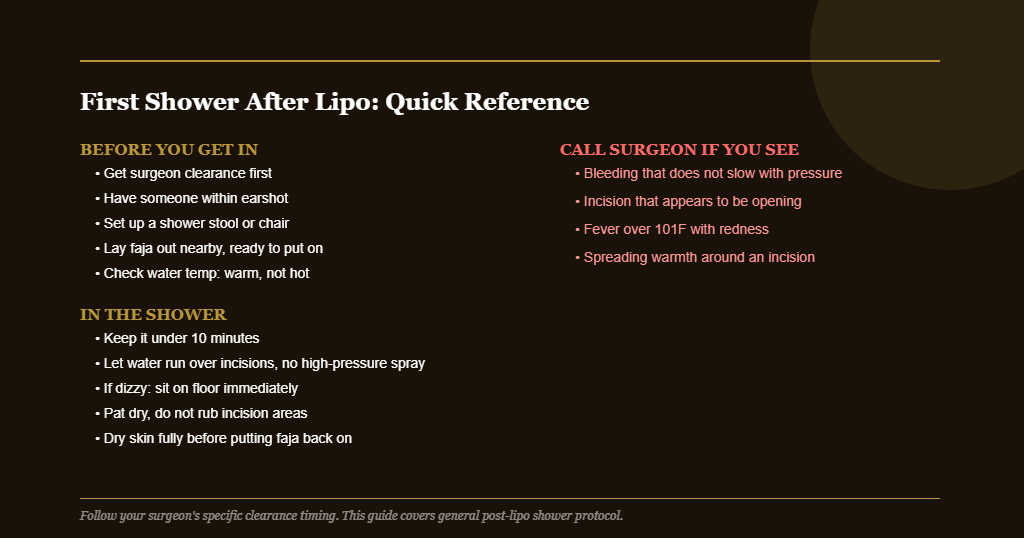
The protocol is simple: keep the water temperature warm, not hot. A hot shower after lipo is not the treat it sounds like, not in the first two weeks. Have someone within earshot for the first shower, even if you feel fine. A shower chair or stool is not a sign of weakness. It is a way to avoid falling onto tile while holding a showerhead. If you feel dizzy, sit down immediately on the floor of the shower and stay there until it passes. Do not try to reach for the handle to turn off the water first.
Water on the Incisions: Temperature, Pressure, and Patting Dry
Warm (not hot) water running over closed incision sites is generally fine once your surgeon has cleared you. Direct, high-pressure spray onto incision sites is not ideal in the first week. If you have a detachable showerhead, the gentler setting works better. If not, let water run over sites rather than blasting them.
Patting dry matters here. Rubbing a towel across incision sites creates friction that early healing tissue does not need. Use a clean towel, pat gently, and make sure incision areas are actually dry before the faja goes back on — if you’re monitoring how your incision sites are healing, the guide on lipo scars explains the healing stages to expect. A damp surface under a compression garment stays damp, which is not what you want against healing skin.
What is not normal: active bleeding from an incision that does not slow with gentle pressure within a few minutes, or an incision that looks like it is pulling apart. Either of those warrants a call to your surgeon before you finish drying off.
The Faja-Off, Faja-On Problem
Getting a snug compression garment off a post-surgical body is work. Getting it back on over damp skin, when you are tired from the shower, is harder. If the faja feels uncomfortably tight when putting it back on, read the guide on whether your faja is too tight before assuming you need a larger size. A few things help: plan to shower at a time when you are not rushing, lay the faja out and ready before you get in, and if possible, time the shower with your faja’s wash cycle so you have a dry backup ready.
The article on how to wash a faja covers care instructions that will help you figure out that rotation schedule. The general principle is that you want at least two fajas so one can wash and dry while you are wearing the other. If you are still figuring out which stage you should be in, the faja sizing guide covers the stage 1 to stage 2 transition timeline. Trying to put a damp faja back on after a shower is miserable and not great for the garment.
If getting the faja back on after showering feels genuinely difficult in the first week, have someone help. The compression itself can wait a few minutes while you get assistance. It cannot wait indefinitely.
A stage 1 faja is the garment you wake up in and live in for the early weeks. The Snatched Body stage 1 faja is the one we recommend; our sizing guide covers how it should fit.
The First Mirror Moment
What you see in the first uncovered shower will be the worst-looking your body will look during this recovery. Bruising moves with gravity, so if you had work done on your abdomen and flanks, you will likely see bruising that has migrated toward your inner thighs and lower body by day four or five. This is expected and it is not a complication.
Patients consistently describe the first mirror moment as something they were not prepared for, even when they thought they were. The swelling is maximum, the bruising is full rainbow, the incision sites are visible, and it looks nothing like what you were expecting your results to eventually be. The useful reframe is this: what you are seeing is the worst-case version of a process that is already working. The swelling is your body doing its job.
What is worth noting and telling your surgeon at the next appointment: asymmetry that seems very significant, hardness in a localized area that feels distinctly different from surrounding tissue, or any area that seems to be getting more swollen rather than less after the first week. None of these are necessarily emergencies, but they are worth a conversation.
When to Call the Surgeon Before the Next Appointment
Call, do not wait, if you see active bleeding that does not slow with pressure, if an incision appears to be opening, or if you develop a fever over 101F alongside any local redness and warmth that is spreading away from an incision site. Those are not “monitor and see” situations.
The checklist in what to pack for lipo surgery day includes thermometer on the supply list for exactly this reason. You want one on hand during recovery, not just at the facility.
FAQ
Can I wash my hair in the first shower after lipo?
Yes, with modifications. The concern is staying upright and avoiding extended periods with your arms raised (which can increase blood flow and be tiring post-surgery). If washing your hair makes you feel dizzy or fatigued, sit down on the shower stool first. Some patients prefer to wash hair on a separate day in the first week, or have someone help at the sink. There is no rule against it, only awareness of your energy limits.
What if my incision site gets wet in the shower? Is that okay?
Once your surgeon has cleared you for showering, water over closed incision sites is generally fine. The concern is submerged or pooled water, not running water. Make sure to pat dry carefully and completely after. If an incision looks different after the shower, such as more red, raised, or open, let your surgeon’s office know.
How long should my first shower be?
Short. Five to ten minutes is reasonable. You are not trying to scrub or soak, you are rinsing and washing gently. The longer you are in warm water while healing, the higher the lightheadedness risk. Get what you need done and get out. There will be plenty of normal showers in a few weeks.
This article is for educational purposes only and is not a substitute for professional medical advice. Always follow your injector’s or surgeon’s specific aftercare instructions.