
There is a satisfying irony built into this question. You just had hyaluronic acid injected into your lips, and now you are wondering whether to apply hyaluronic acid serum on top of them. The molecule has the same name. The effect is completely different. Understanding why is more useful than any buying guide.
The Same Name, Two Different Jobs
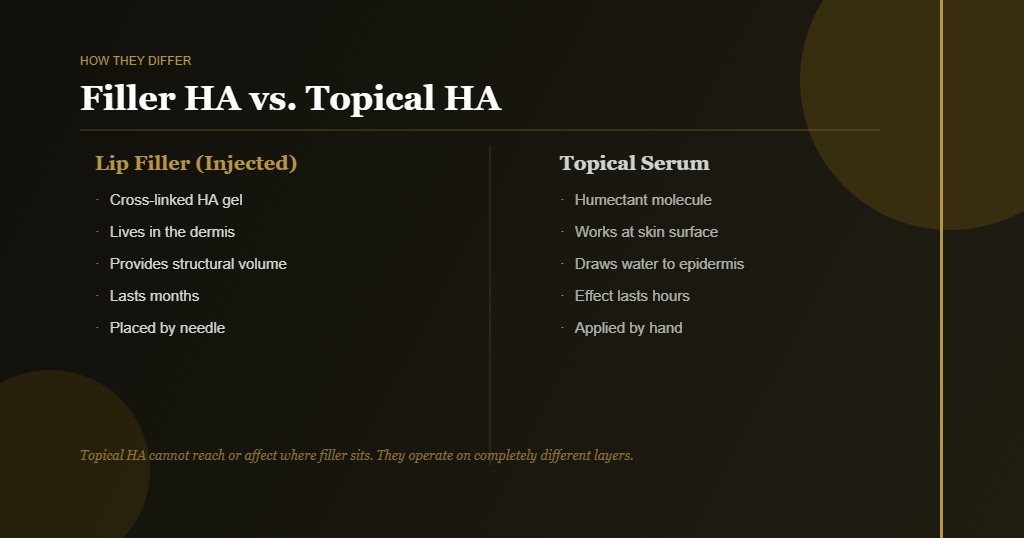
Lip filler is a cross-linked hyaluronic acid gel. The cross-linking is what makes it structural: it creates a dense, stable network that holds its shape under tissue pressure and gives volume that lasts months. It sits in the dermis, far below the skin surface, where it attracts water and creates fullness. Your injector placed it there with a needle. It will not move based on anything you apply topically.
Topical hyaluronic acid serums are humectants. They work at the skin surface, pulling water from the surrounding environment (and sometimes from the deeper layers of your skin) into the uppermost layer of the epidermis. The HA molecules in most serums are too large to penetrate to the dermis anyway, and even fragmented lower-molecular-weight versions that penetrate slightly deeper are still operating nowhere near where filler sits. Topical HA cannot top up filler, supplement it, or affect its behavior. Any serum that claims otherwise is making claims the mechanism does not support.
None of that makes topical HA useless on recovering lips. It just means it is being useful in a completely different way.
What Topical Hyaluronic Acid Actually Does for Post-Filler Lips
The first week or two after lip filler is not a comfortable time for the lip surface. There is swelling, some tenderness, and frequently a degree of dryness and flaking as the skin adjusts. The lip surface can feel tight, and the natural shedding of surface skin cells creates visible flaking that most patients find frustrating, especially since they cannot exfoliate it away yet.
A lightweight HA serum addresses the surface dryness directly. It draws moisture into the uppermost skin layers, reduces the tight, papery sensation that comes with mild dehydration, and makes the flaking less pronounced by keeping the surface plumped with water. These are real, noticeable benefits during a period when your options for lip products are limited.
It is also one of the least irritating things you can apply to skin that is still settling from punctures. HA is well-tolerated, not known for sensitivity reactions, and does not interfere with healing. For a recovering surface, that relative safety matters as much as the efficacy.
The Timing Question
The injection sites on your lips are small punctures. For the first day or two, they are open channels into tissue, which is exactly why your injector advises against applying anything to the area immediately after treatment. Introducing a product to open puncture sites creates infection risk and is worth avoiding regardless of how gentle the product is.
Most injectors clear patients to return to normal skincare and lip products within a day or two, once puncture sites have closed. The specific instruction from your injector overrides any general timeline, because some patients, especially those with multiple puncture sites or visible bruising, may need to wait a little longer. The 7-day lip filler recovery timeline gives a clear picture of what is happening in the skin day by day, which makes timing decisions easier to calibrate against your own healing. If you’re also feeling small firm areas through the lip, the guide on lumps after lip filler explains what’s normal and what to monitor.
The Humectant Catch You Should Know
Hyaluronic acid pulls water. Where it pulls from matters. In a humid environment, it draws moisture from the air around you, which is the ideal scenario. In a very dry environment, it can draw moisture up from deeper skin layers instead, which can leave the surface feeling tighter rather than more hydrated a few hours after application.
The solution is simple and often skipped: apply HA serum and then immediately layer a bland, occlusive balm over it. The balm traps the water the HA has pulled to the surface and prevents it from evaporating. On its own, HA on dry lips in a dry environment can be a net negative. HA under a plain petroleum-based or lanolin-based balm is genuinely effective. Most patients using serums without a sealing layer are not getting the benefit they think they are.
Reading the Label Honestly
HA product labels have become dense with marketing language. Molecular weight claims (“low molecular weight HA penetrates deeply”) are technically accurate at a basic science level but commercially overblown: the penetration achieved by low-MW HA in a topical serum still does not reach the dermis where filler lives, and the difference between molecular weights in real-world products is smaller than the claims suggest.
What to actually look for: fragrance-free, no alcohol listed high in the ingredients (it is drying and irritating on healing skin), and no exfoliating acids or retinol in the same formula. On recovering lips, the goal is gentle and hydrating, not active or transformative. Save the actives for when you are fully healed.
Plumping glosses that use cooling or tingling ingredients to create the sensation of fullness are a particular category to avoid on fresh filler. Many use irritants like cinnamon oil, menthol, or capsicum derivatives. On compromised tissue, these cause redness, sensitivity, and swelling that has nothing to do with any cosmetic benefit. The honest answer is that plumping glosses do not add volume in any meaningful way even on healthy lips; on recovering lips, they are simply an irritant.
The ingredients worth knowing more about in the context of post-procedure healing extend into the peptide category. If you are curious about how topical actives work on skin that has recently had a procedure, the comparison with copper peptides after microneedling is a useful reference point for understanding what “active on the surface” actually means versus what it cannot do.
Do You Actually Need a Serum?
Probably not, if your alternative is a plain, fragrance-free, petroleum-based lip balm. A good balm handles the occlusion that HA needs to perform, and it handles it without the serum step that many patients forget to seal. The patients who notice the most benefit from an HA serum are those who use it correctly: apply the serum, wait thirty seconds, apply the balm on top. That is two products used in the right order. Used in the wrong order or without the sealing step, the serum is doing less than a plain balm alone.
If you already have a good HA serum and want to use it on recovering lips, the timing and layering approach above make it worth it. If you are buying something new specifically for post-filler care, the plain balm is the less complicated and equally effective starting point. A dedicated serum adds convenience and a small legitimacy boost to your routine, but it is not filling a gap that would otherwise be left open.
FAQ
Can hyaluronic acid serum make my lip filler last longer?
No. Topical HA does not interact with the cross-linked HA gel that makes up your filler. The mechanisms are entirely separate: one operates at the skin surface as a humectant, the other is a structural gel in the dermis. Filler longevity is affected by your metabolism, the product used, and the area treated, none of which topical HA influences.
When can I apply a lip serum after filler?
Most injectors clear basic lip products once puncture sites have closed, which typically happens within the first day or two. Your injector’s specific instruction takes priority over any general timeline. If you are unsure, waiting until the morning after your appointment and then checking with your provider before adding products is the low-risk approach.
Is HA serum safe to use on healing lips?
Once puncture sites are closed, a fragrance-free HA serum is one of the gentler options available and is generally well-tolerated on recovering skin. The main risk is applying it before sites are fully closed (infection risk) or using a formula that contains irritants like fragrance, alcohol, or plumping agents that will cause unnecessary sensitivity at a time when the tissue is already reactive. Read the ingredient list before you apply anything.
This article is for educational purposes only and is not a substitute for professional medical advice. Always follow your injector’s or surgeon’s specific aftercare instructions.