
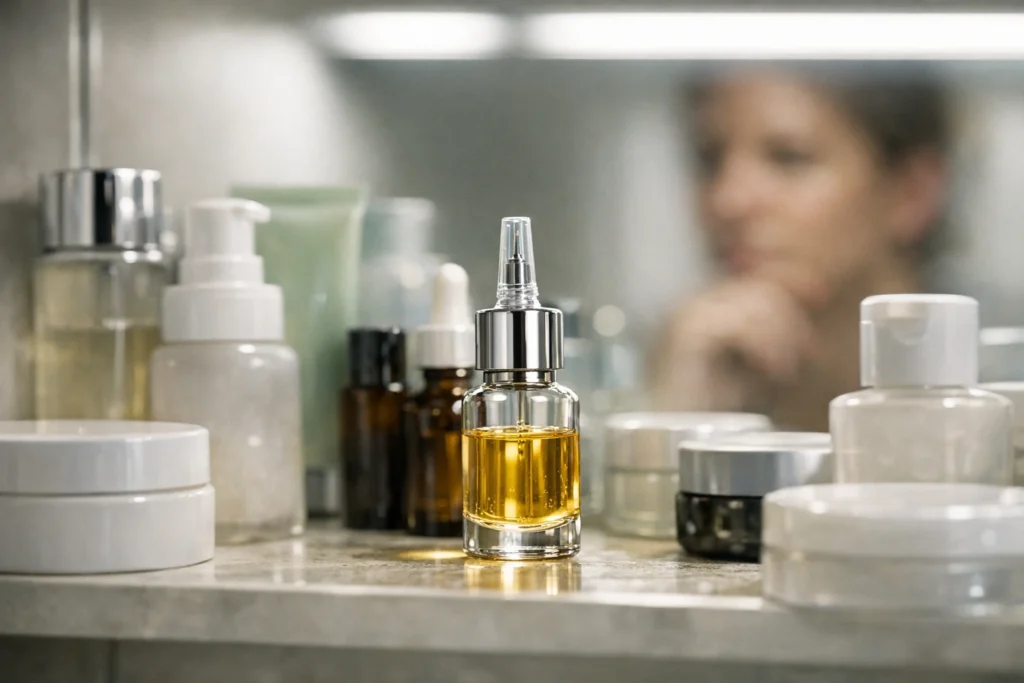
You have a serum on the bathroom shelf that cost more than the rest of the shelf combined, and its label says peptides in a font that suggests they are doing something. Somewhere else, maybe a wellness clinic or a corner of Reddit, someone is telling you the real results come from injecting peptides, not smearing them on.
The assumption underneath both is that these are the same thing at different strengths. They are not. The gap between injectable vs topical peptides is not a dial from mild to strong. It is the difference between a molecule that gets into your skin and one that mostly sits on top of it, and once you see that, most of the marketing on both sides falls apart.
In a hurry? Jump to the common questions for the short answers.
The short version
Most topical peptides are too large to cross the skin barrier in meaningful amounts, so a lot of what you pay for stays on the surface. Injectable peptides bypass that barrier completely, which is exactly why they are a medical decision and not a shopping one: the popular injectable peptides are not FDA-approved, have little human safety data, and grey-market versions have tested contaminated. Small, well-formulated topical peptides can still earn a place in a routine. Injectables belong in a conversation with a qualified medical provider, not a checkout cart.
What a peptide is, and why size decides everything
A peptide is just a short chain of amino acids. The regulators draw the line at forty or fewer; past that you are into larger proteins. That is the whole substance behind a word that gets used like a spell.
Here is the part the serum box will never tell you. Your skin’s outer layer exists to keep things out, and it is very good at it. Decades of transdermal drug research converged on a rough cutoff, sometimes called the 500 Dalton rule: molecules much heavier than about 500 Daltons struggle to pass through the surface on their own in any useful amount.
Now put the popular cosmetic peptides against that number. The pentapeptide sold as Matrixyl lands around 800 Daltons. The hexapeptide sold as Argireline sits near 890. Both are above the cutoff. Collagen and growth factors are heavier again, into the thousands and beyond. Which means a large share of the “peptide” and “collagen” serums on the market cannot get their headline ingredient through the barrier without help, no matter how good they feel going on.
The topical peptides that are actually worth it
This is not a reason to throw out the whole category. It is a reason to be picky.
Not every peptide is oversized. Copper tripeptide is genuinely small, well under the size where the barrier becomes the wall, which is a big part of why it keeps its reputation when flashier ingredients lose theirs. Formulation matters just as much as the molecule. A lipid tail bolted onto a peptide, a good penetration system, or a mechanical route past the surface can change what actually gets in. Microneedling is the clearest example: the channels it creates let larger actives move past the barrier they would otherwise bounce off, which is why peptides and copper peptides after microneedling get talked about together so often.
So the honest buying rule for topical is short. Choose for molecule size and formulation, not for the word on the front. A small, well-delivered peptide can do real cosmetic work. A large one in a pretty bottle is mostly paying for the bottle.
| Topical peptides | Injectable peptides | |
|---|---|---|
| Gets past the skin barrier | Mostly no, unless small or well delivered | Yes, it skips the barrier entirely |
| Regulatory status | Sold as cosmetics, over the counter | Not FDA-approved for these uses; a grey zone |
| Human safety data | Reasonable for common cosmetic peptides | Minimal |
| Who controls what goes in | You, and the stakes are low | A medical provider, or nobody if grey-market |
| Main real-world risk | Overpaying for molecules that stay on top | Contamination, impurities, unknown long-term effects |
| Reasonable use | A routine, if you pick small and well-formulated | Medical supervision only |
Why injectable peptides are a different universe entirely
Injecting solves the size problem in the most direct way possible: it goes around the skin instead of through it. That is the appeal. It is also the reason the whole conversation changes.
The peptides people inject for healing, recovery, or anti-aging, the ones with names like BPC-157 and its cousins, are not FDA-approved for human use. They have no recognized pharmacy standard, sit in a contested regulatory grey area, and carry very little human clinical evidence. Many are sold with a “research chemical, not for human consumption” label, which is a legal shrug, not a safety endorsement.
The supply is the sharper problem. When independent labs have tested grey-market peptide vials, they have found bacterial contamination at levels that can cause serious reactions, residue left over from manufacturing, and in some cases less than half the peptide the label promised. You are not just gambling on whether the compound works. You are gambling on what is actually in the bottle. The same honesty gap runs through the wider regenerative trend, which is worth reading about in the PDRN evidence once you start pulling on these threads.
A pattern shows up if you spend any time in these communities: the enthusiasm runs years ahead of the human data, and the people selling the loudest are almost never the ones who ran the trials. Bypassing your skin barrier is not a life hack. It is a medical act, and it deserves medical supervision.
REASONABLE TO DECIDE YOURSELF
Choosing a topical peptide serum. Picking it for molecule size and formulation rather than the label. Adding microneedling-assisted delivery with proper aftercare. Skipping the large-molecule “collagen serum” that cannot absorb in the first place.
BELONGS TO A MEDICAL PROVIDER
Anything injected. Any “research chemical” peptide. Anything labeled not for human consumption. Sourcing vials online. Treat unbranded vials, no pharmacy, and dosing tips from a forum as red flags, and take the whole question to a qualified provider who can weigh how unregulated these compounds are.
So which one do you actually need
Most people asking this are shopping for their skin. For skin, the honest answer is topical done right: small, well-formulated peptides, realistic expectations, and a delivery method that helps them get where they are going. That is a low-stakes decision you can make on your own.
If your goal is what the injectable world advertises, the healing and regeneration and longevity claims, the human evidence is thin and the safe road runs through a medical provider who can weigh the near-total lack of regulation. It does not run through a vial you reconstitute on your kitchen counter from a seller you found last week.
The question is rarely injectable or topical. It is usually whether the thing you are about to buy can even reach the place it claims to fix. For most topical peptides the answer is barely, and for most injectable ones the answer arrives with a stranger’s guess at what is really in the bottle.
Common questions
Are topical peptides a waste of money?
Not always. Large-molecule peptides that cannot cross the barrier are mostly surface theater. Small, well-formulated ones, and peptides delivered with help such as after microneedling, can do real cosmetic work. Buy for the molecule and the formulation, not for the word on the front.
Are injectable peptides like BPC-157 safe or legal?
They are not FDA-approved for human use and sit in a regulatory grey zone with little human safety data. Grey-market products have tested contaminated and mislabeled. If you are considering them, that is a conversation for a qualified medical provider, not a purchase to make on your own.
Can I just microneedle my peptide serum in to skip the size problem?
Microneedling does improve how much gets past the surface, which is why it pairs with peptides. It also breaks the barrier, so sterility and the right aftercare matter, and not every active is safe to drive deeper. Follow proper microneedling aftercare and check the specific ingredient, not just the peptide label.
This article is for educational purposes only and is not a substitute for professional medical advice. Always follow your injector’s or surgeon’s specific aftercare instructions.