
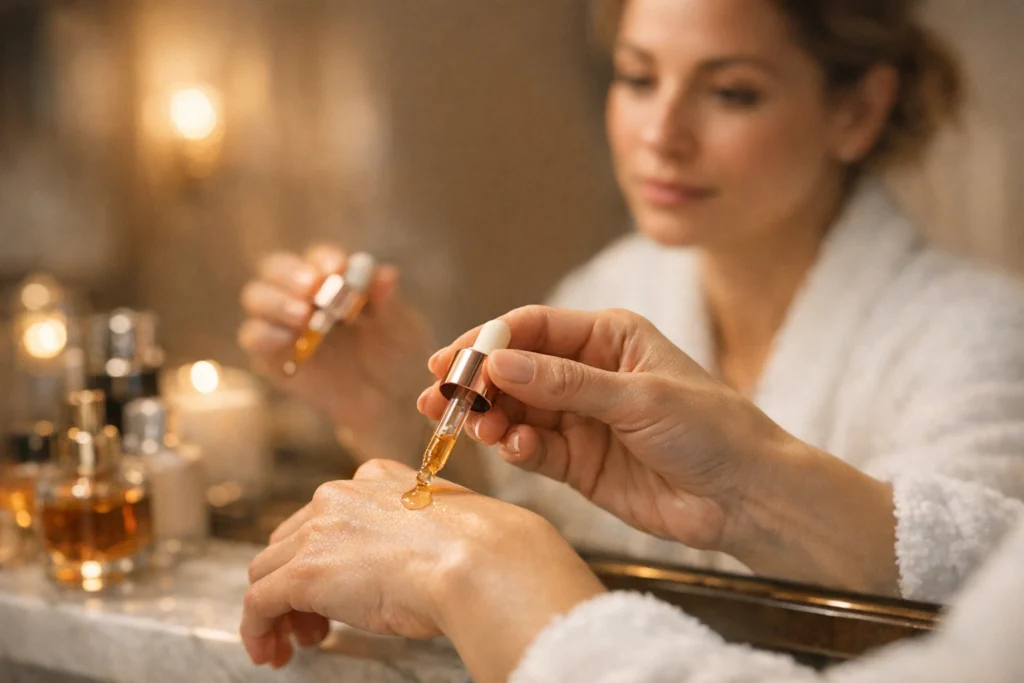
Scroll through skincare social media right now and you’ll see the same little amber bottle everywhere, all promising the same copper-toned miracle. GHK-Cu copper peptide has become the ingredient of the moment, credited with everything from firmer skin to thicker hair to weight loss, and that last claim alone should make you suspicious. Some of what’s being said is real. Most of it isn’t.
If you just want the short version of what to expect from a GHK-Cu serum, skip to the FAQ.
GHK-Cu is a copper-binding peptide with genuinely solid evidence for topical skin repair: it supports collagen and elastin production and helps wound healing. The hair growth and weight loss claims attached to it are not well supported by clinical evidence. Topical use is different from injectable use, and this article covers the topical, cosmetic side only.
What GHK-Cu Copper Peptide Actually Is
GHK-Cu is a naturally occurring copper-binding tripeptide, three amino acids: glycine, histidine, and lysine, first isolated from human plasma back in 1973. Your body makes it on its own, and like a lot of things involved in tissue repair, levels decline as you age. That decline is part of why researchers got interested in the first place: less GHK-Cu circulating seems to line up with slower repair.
Where the Evidence Is Genuinely Strong
This is the part that holds up. GHK-Cu signals fibroblasts, the cells responsible for producing collagen and elastin, to get to work rebuilding the skin’s support structure. It supports the extracellular matrix, the scaffolding that keeps skin firm, and shows antioxidant and anti-inflammatory activity along with a role in wound healing.
A pilot study of topical copper tripeptide in aged skin reported improvements in skin thickness, hydration, and elasticity, along with increased collagen. That’s a real, measurable result, even if it’s one pilot study rather than a mountain of research. Topical cosmetic use is generally well tolerated, which is part of why this ingredient has earned a real spot in serious skincare formulations rather than staying a curiosity.
Where Marketing Has Outrun the Data
Hair growth and weight loss are the two claims doing the heaviest lifting in advertising right now, and neither holds up well under a critical read. The hair growth angle is mostly built on preclinical or scalp-specific research rather than solid clinical trials in people, and weight loss claims have essentially no proven clinical evidence behind them. If a product description promises thicker hair or a smaller number on the scale because of a copper peptide serum, that promise is running well ahead of what anyone has actually shown.
Topical Versus Injectable: Two Different Conversations
Topical use and injectable use are not interchangeable, and long-term systemic use of GHK-Cu has not been well studied. This article sticks to topical, over-the-counter cosmetic use for exactly that reason. Any decision about injectable peptides belongs in a conversation with a licensed prescriber, not a product review, and that holds regardless of what a seller’s website claims.
The Nuance Most Sellers Skip
Here’s something copper peptide marketing rarely mentions: part of the collagen-boosting effect attributed to GHK-Cu may actually come from the copper ion itself, not the peptide structure carrying it. That doesn’t make the ingredient fake. It means the mechanism is messier than a single-molecule miracle story, and it means concentration matters. Higher concentrations of GHK-Cu can irritate skin, so more is not automatically better.
Normal reaction to introducing a new copper peptide serum is mild tingling or slight redness that fades within an hour. Increasing redness, swelling, or itching that doesn’t settle down, or any sign of an allergic reaction, means stop using it and check with a dermatologist rather than pushing through it.
How to Introduce a Copper Peptide Serum Without Guesswork
Start with a lower concentration and use it every other night for the first two weeks. That gives your skin time to show you how it reacts before you commit to daily use. Copper peptides play reasonably well with most routines, but timing matters more than people expect.
Direct vitamin C, especially the acidic L-ascorbic acid form, and copper peptides are usually kept apart. Applying them in the same routine can make each one less effective, so most formulators suggest using one in the morning and the other at night, or alternating them by day. The same caution applies to strong exfoliating acids. A serum applied to freshly exfoliated skin will absorb differently, and not always in a good way. None of this is complicated once you know it, which is exactly why it is frustrating that so few product pages mention it.
Packaging matters more than shoppers realize too. Copper peptides oxidize with prolonged light and air exposure, which is why serious formulations tend to come in opaque or amber bottles with a pump or dropper rather than a jar. If a product is sold in clear glass and you notice the color shifting over a few months, that is a reasonable sign the formula is degrading, not a placebo effect in your head.
Where This Fits Into a GLP-1 Skin Routine
If you’re managing the skin side of rapid weight loss, a GHK-Cu serum is a reasonable supportive addition to a routine, alongside retinoids, SPF, and hydration. It is not a replacement for the volume or tightening treatments covered in our ranked breakdown of ozempic face treatments, and it won’t reverse hollowing or significant laxity on its own. Think of it as one supporting player, not the lead.
If you’ve had microneedling as part of your routine, our guide to copper peptides after microneedling covers timing in more detail, since layering a new active around a procedure is its own separate question from using one on undamaged skin.
Frequently Asked Questions
Does GHK-Cu actually help with hair loss?
Not based on solid clinical evidence. Most of what supports a hair benefit comes from preclinical or scalp-focused research rather than robust human trials, so the marketing here is well ahead of the science. If hair shedding is your main concern, that’s worth raising directly with a dermatologist rather than relying on a serum.
Is a stronger GHK-Cu concentration better?
Not necessarily. Higher concentrations can cause skin irritation, and part of the ingredient’s benefit may come from the copper ion itself rather than a straightforward dose-dependent peptide effect. More isn’t automatically more effective here.
Is topical GHK-Cu the same as injectable GHK-Cu?
No, and this article only covers topical, cosmetic use for that reason. Long-term systemic or injectable use hasn’t been well studied, and any medication or injectable decision belongs with a licensed prescriber, not a skincare review.
This article is for educational purposes only and is not a substitute for professional medical advice. Always follow your injector’s or surgeon’s specific aftercare instructions.