
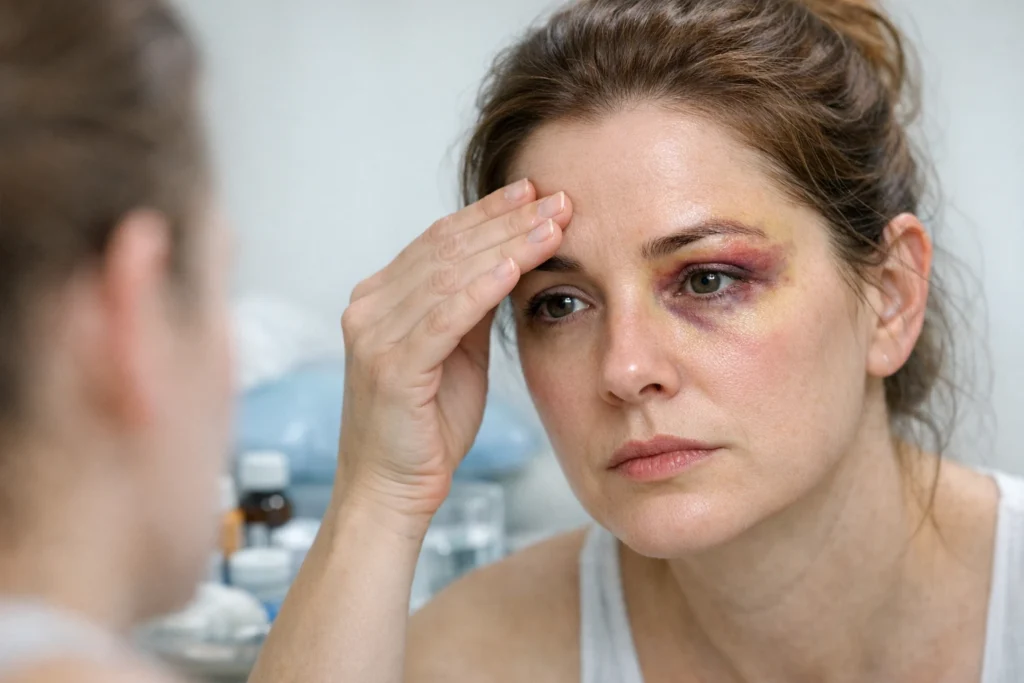
You probably knew about the bruising and the swelling. You expected some tightness. What almost nobody tells you before a brow lift is that your scalp is going to go numb, and not briefly. It can be numb for weeks, then tingle and prickle for weeks after that, then gradually return to normal over months. Patients who weren’t warned about this consistently describe a period of genuine panic. This article exists to prevent that.
Quick Answer
Most brow lift patients return to desk work at 10 to 14 days. Swelling and bruising peak at days 2 to 4, then decrease rapidly. The scalp and forehead numbness that follows is normal and expected, progressing through a tingling or prickling phase as nerves regenerate between weeks 2 and 5. Final brow position settles by 3 months. Full recovery, including subtle swelling, takes up to 6 months.
Jump to: Frequently Asked Questions
The Scalp Numbness Arc: What Nobody Explains Before Surgery
The numbness starts almost immediately after surgery and typically extends from the hairline across the forehead, sometimes including the top and back of the scalp depending on the approach used. For the first one to two weeks, it is often a flat, complete numbness. You can touch the area and feel pressure, but the skin surface sensation is gone.
Then, somewhere between days 14 and 35, things get stranger. The numbness transitions into tingling, prickling, or what patients often describe as an electric crawling sensation. This is not a bad sign. It is nerves regenerating. The sensation can be mild or it can be genuinely annoying, particularly at night when there are fewer distractions. It is a sign of recovery, not a complication. The nerve recovery after cosmetic surgery guide explains the mechanism behind this sequence in detail, including what separates temporary neuropraxia from more significant nerve involvement.
Most sensation returns by 3 to 6 months. For some patients, small patches of scalp near the incision may remain slightly less sensitive long-term without causing any meaningful bother. This is documented and expected. What is not expected is that your surgeon will always mention it unprompted, which is why patients who were not told panic when it happens.
There is a practical consequence worth taking seriously: avoid heat tools near the scalp until sensation is fully back. A hair dryer set to high, a curling iron, a straightener near the hairline. You cannot feel burning in a numb area. This is not theoretical. It appears in multiple post-operative protocols for exactly this reason.
The Brow Position Will Look Wrong for Weeks. That Is Normal.
The brow sits higher than its final position immediately after surgery. Sometimes noticeably so. This is because the tissues are swollen and the brow has been lifted and secured in a position that accounts for some drop during healing. What you see at week two is not the final result.
Final brow position is established by approximately 3 months, as the tissues relax and the residual swelling resolves. Some patients find the early position alarming, particularly if they were hoping for a subtle result. The advice to not judge the outcome until 3 months is not generic reassurance. The position genuinely moves during this period.
Brow Lift Recovery: Week by Week
The recovery timeline below reflects the endoscopic approach, which is the most common technique used today. Endoscopic brow lifts use small hidden incisions within the hairline, produce the least scarring, and typically have the fastest healing. Coronal lifts (longer incisions across the top of the scalp) and direct lifts have longer recoveries and more significant numbness patterns. If you have had a different technique, confirm with your surgeon which parts of this timeline apply.
| Timeframe | What to Expect |
|---|---|
| Days 1 to 2 | Swelling, bruising, forehead tightness. Head elevated at all times. Headband in place. |
| Days 2 to 4 | Swelling peaks. Eyes may partially swell shut at 36 to 48 hours. Cool compresses as directed. |
| Days 5 to 14 | Bruising fades. Swelling decreases noticeably. Scalp numbness fully present. Light activity begins. |
| Around Day 21 | Staples or sutures removed. Headband moves to nights only. Light makeup typically fine. |
| Days 14 to 35 | Tingling and prickling sensations as nerves begin to regenerate. Normal and expected. |
| Months 1 to 3 | Brow position settles into final placement. Return to most activities with clearance. |
| Months 3 to 6 | Most residual numbness resolves. Final results visible. Subtle swelling fully gone. |
Return to non-physical desk work typically happens between days 10 and 14. Most surgeons clear light exercise around weeks 2 to 3 and strenuous exercise at weeks 4 to 6, though some request that you wait the full 6 weeks. This is surgeon-specific and you should follow your own protocol. Do not massage or apply tension to the incision areas for at least 4 weeks.
Patients who have had blepharoplasty may notice that recovery overlaps in interesting ways. The blepharoplasty recovery guide covers the specific eyelid healing process, which runs on a different timeline from forehead recovery even when both are done in the same procedure. And if you are considering a brow lift after a rhinoplasty or are recovering from both, the rhinoplasty recovery guide covers the nasal swelling arc that may be happening alongside forehead healing.
The Headband: More of a Commitment Than You Were Told
For endoscopic brow lift patients, a compression headband worn continuously for the first three weeks is part of the standard protocol. The headband maintains the scalp position while the tissues heal and anchor in their lifted position. After day 21, when sutures or staples are typically removed, the headband shifts to nights only for a further three weeks.
Six weeks of headband wear, starting at 24 hours a day. This is a commitment that surprises patients who were told only “you’ll wear a bandage for a bit.” The nights-only phase is genuinely disruptive to sleep for some people because the elastic feels tight. This is not a reason to skip it. The headband is doing structural work while the scalp tissues heal in position.
What Is Normal and What Warrants a Call
Patients consistently describe the end of week one as the moment they feel most alarmed, because the initial dressings are off and the result is fully visible for the first time: swollen, bruised, the brow sitting high. All of this is normal. Asymmetry that looks pronounced in week one frequently resolves on its own as swelling drops unevenly on each side.
Normal
- Scalp numbness extending from hairline to forehead
- Tingling or electric prickling sensations in weeks 2 to 5
- Brow sitting higher than expected in first 4 to 6 weeks
- Forehead tightness and dry eye sensation for first few weeks
Call Your Provider
- Fever, increasing redness or warmth at incision sites
- Swelling worsening after day 5 rather than improving
- Asymmetry that looks worse at week 2 than week 1
- Numbness that does not shift at all by 8 to 10 weeks
The numbness question is worth watching carefully. Some change in sensation, some prickling, some shift in the quality of the numbness should be present by 8 to 10 weeks. Total absence of any change by that point is worth raising. It does not necessarily indicate a problem, but it is outside the typical pattern and your surgeon should know.
What the Result Actually Looks Like Long-Term
Brow lifts typically last 5 to 10 years. The result at 6 months is genuinely different from the result at 3 months, and the result at 3 months is different from the result at 6 weeks. The final settled brow, once numbness has fully resolved and the tissues have stabilised, is usually softer and more natural-looking than what you saw in the early post-operative period.
Very fine residual swelling in the forehead can persist up to a year in some patients, particularly noticeable in certain lighting. This is documented. It is not a reason to panic at month nine.
Frequently Asked Questions
How long does scalp numbness last after a brow lift?
Most numbness progresses through phases: flat numbness in the first two weeks, then tingling and prickling from around days 14 to 35 as nerves regenerate, then gradual return of normal sensation. For most patients, the majority of sensation has returned by 3 to 6 months. Occasional small patches near the incision line may remain less sensitive long-term, but this is typically not bothersome.
When does brow position settle after a brow lift?
The brow sits noticeably higher than its final position immediately after surgery. This is intentional, as surgeons account for the natural drop during healing. Final position is established by approximately 3 months. Judging the result before that point, especially in the first six weeks, will almost always look more dramatic than the actual final outcome.
Can I use heat tools on my hair after a brow lift?
Not until scalp sensation has fully returned. The reason is practical: numb skin cannot register temperature, so a hot hair dryer or curling iron near the hairline creates a burn risk you would not feel until the damage was done. Most surgeons recommend waiting until normal sensation has returned before using any heat styling tools near the scalp.
This article is for educational purposes only and is not a substitute for professional medical advice. Always follow your injector’s or surgeon’s specific aftercare instructions.