
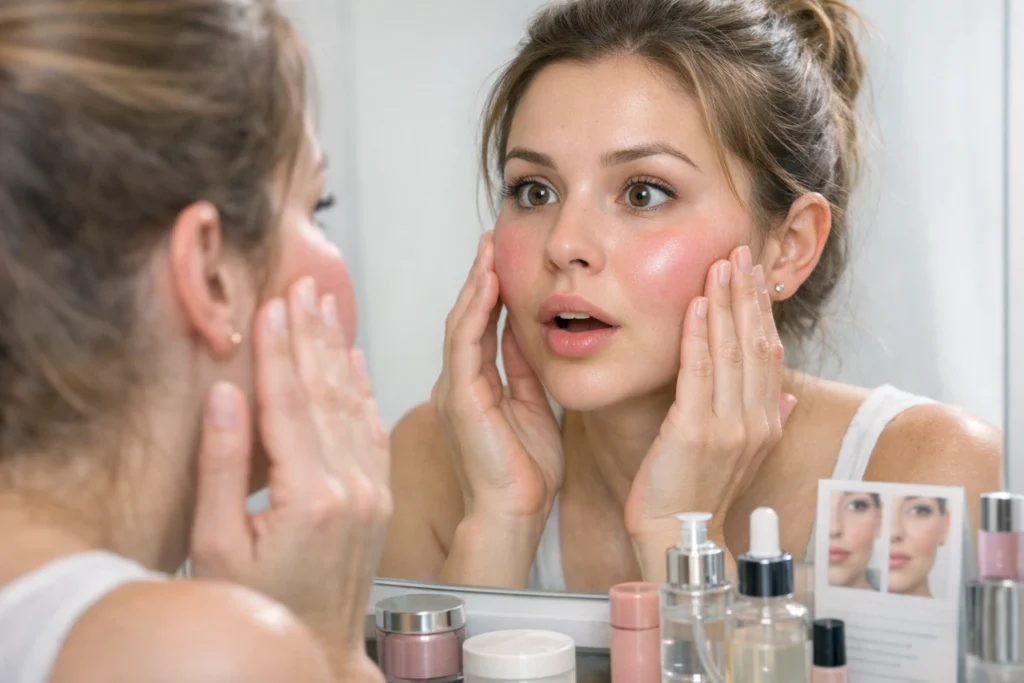
It is the day after and your cheeks look dramatically different from how you expected them to look. Not a little puffier. Dramatically puffier. The right side is noticeably more swollen than the left. You had lip filler before and you know the drill, but this is not the lip filler drill. Nobody told you it would be this pronounced. For a sense of how cheek filler recovery compares to the more familiar 7-day lip filler recovery timeline, the differences are more significant than most patients expect.
Cheek filler swells more dramatically than lip filler, settles more slowly, and the final result takes up to four weeks to be visible. Patients who know this don’t spiral at day two. Patients who don’t know this often push for early correction of a result that hasn’t finished settling.
Looking for a quick answer? Jump to the FAQ below.
The short answer
Cheek filler swells more dramatically than lip filler and takes longer to settle. Swelling peaks at 24-72 hours and most resolves in 1-2 weeks, but the true final result is not visible until weeks 3-4. Mild asymmetry in the first two weeks is almost always swelling, not a placement problem.
Why Cheek Filler Swells More Than Lip Filler
The lip border is a small area injected superficially with relatively low volumes of thin product. The cheek is a larger treatment area with deeper injection planes and more tissue volume. Products used for cheek augmentation are typically higher G prime, thicker, and more hydrophilic than lip filler products. A more hydrophilic product in a larger tissue volume draws more water from surrounding tissue and creates more initial swelling. The cheek also has different lymphatic drainage patterns than the lip, which affects how quickly swelling clears.
None of this is abnormal. It is just physics applied to facial anatomy, and it means your post-treatment experience will look nothing like your friend’s lip filler photos.
Cheek Filler Recovery Timeline: Day by Day
Cheek filler swelling usually peaks within the first 24-72 hours and the majority diminishes within 1-2 weeks. Most swelling resolves within 7-10 days. That is the general pattern. Here is what the specific days look like.
Days 1-2 bring significant swelling, tenderness, and possible bruising at injection sites. It is normal for one side to swell more than the other in the initial healing phase. Asymmetry is extremely common at this stage and almost universally due to different tissue responses and swelling on each side, not unequal placement.
Days 2-3 are the peak. This is the most alarming point, and the point at which patients most often make decisions they later regret. The face may look very different from the expected result. The cheeks may look significantly overfilled. This is swelling. The filler is underneath it.
Days 4-7: swelling reduces noticeably. The face starts to look like itself plus some volume. Asymmetry often begins to even out as swelling reduces at different rates on each side. The shape becomes more legible.
Week 2: most acute swelling is resolved. An early contour is visible. The filler still feels firm and slightly elevated from its final resting position. Some patients still feel significant hardness in the cheek area. This is normal, and it is not the result.
Weeks 3-4: filler integrates into surrounding tissue, softens, and settles. This is when the actual result becomes assessable. Mild lumps and firmness are common in the initial weeks and typically soften within four weeks as the filler integrates.
Months 2-3: complete swelling reduction can take 3-6 months on average, though the majority resolves in the first 2-4 weeks. The final 20% of swelling can take 1-3 months to fully resolve. This is the settled result.
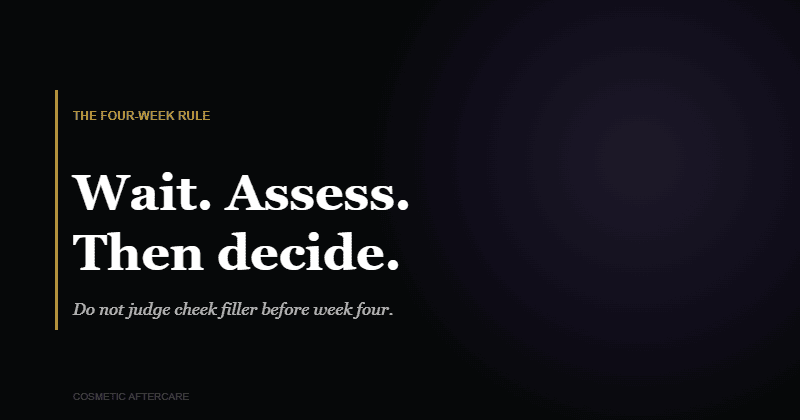
Cheek Filler Recovery Timeline
| Period | What Happens | Key Point |
|---|---|---|
| Day 1-2 | Significant swelling, tenderness, possible bruising. Asymmetry is normal. | This is not the result. |
| Day 2-3 | Swelling peaks. Face looks fullest here. | Do not assess. Do not dissolve. |
| Day 4-7 | Swelling reduces. Asymmetry begins to even. Shape starts to emerge. | Normal healing. |
| Week 2 | Most acute swelling resolved. Early contour visible. Filler still firm. | Earliest meaningful assessment. |
| Week 3-4 | Filler softens and integrates. Closest to final result. | Assess here if concerned. |
| Month 2-3 | Residual swelling fully resolved. Final settled result visible. | Complete result visible now. |
Aftercare That Differs From Lip Filler
Sleep on your back or with a travel pillow that prevents compression of the cheek area for the first week. This is different from lip filler where sleeping position matters less. The cheek treatment area is larger, and sustained pressure from pillow compression can affect how swelling distributes.
Do not massage the cheeks. This is the opposite of what some injectors recommend for lip filler lumps. Cheek filler sits in deeper tissue planes, and self-manipulation is more likely to cause problems than solve them. If you feel a lump that concerns you, contact your injector. Do not attempt to work it out yourself.
No heat, no exercise for 24-48 hours. No dental work for 2 weeks. The same pre-treatment avoidance list for blood thinners, alcohol, and supplements applies here as for any filler. The first 24 hours are the period of highest risk for swelling expansion. The same principles apply if you are treating other areas: our chin filler aftercare guide covers what changes when filler sits on the chin.
The Asymmetry Question and When to Worry
Mild asymmetry in the first two weeks is almost always swelling. Most faces are naturally asymmetric, and equal volumes of filler on an asymmetric face will look unequal as swelling behaves differently on each side. Equal swelling is not even swelling.
This same two-week patience rule applies to lip filler, as covered in the guide on uneven lip filler and when asymmetry is a placement issue versus a swelling issue. The same logic applies here, but the timeline is longer. For cheeks, assess at four weeks before requesting a correction. Requesting correction at day two or even day seven is requesting correction of swelling, not of the result.
The “pillow face” look that patients associate with overfilled cheeks is almost always a photo taken in the first 48-72 hours of swelling. Judging cheek filler before week two is the most common reason patients request dissolution of results that would have been exactly what they wanted if they had waited. If you are at week four and genuinely concerned, then the conversation about dissolving filler becomes relevant. Before that point, the result has not finished forming.
Patients who photograph their cheeks daily in the first week and compare the photos to the expected result consistently report more distress than patients who put their phone down until week two. The daily variation in swelling looks dramatic as a series of photos. It is normal healing.
This is normal
Cheeks looking significantly more swollen than expected in the first 3 days
One cheek swelling more than the other in the first two weeks
Firmness and a slightly elevated feel to the cheeks for up to two weeks
Final result not visible until week 3-4
Residual firmness that takes 4+ weeks to fully soften
Call your injector if
Swelling that is still significantly worsening after 72 hours
Redness, heat, and pain concentrated in one area that is getting worse — signs of infection
Skin blanching or significant colour change in the cheek area
Hard lump that is not changing at all after four weeks
Any vision changes, which can indicate vascular involvement requiring urgent attention
Frequently Asked Questions
Cheek filler aftercare is relatively standard compared to nasal filler, which has a significantly higher vascular risk profile. The nasal blood supply connects to the ophthalmic artery, making vascular events there more consequential than at any other facial filler site. If you are also considering nasal filler, the liquid rhinoplasty aftercare guide covers the extra precautions that apply specifically to that site.
When can I safely assess my cheek filler results?
Week two is the earliest point where a meaningful assessment can be made, and even then some patients will have residual firmness and minor asymmetry from swelling. Week four is the standard benchmark for a close-to-final result. If you have concerns at week four, contact your injector. Concerns before week four are almost always swelling concerns, not result concerns.
Why is one cheek more swollen than the other?
Asymmetric swelling after cheek filler is normal and extremely common. It occurs because tissue responses and lymphatic drainage differ on each side of the face, which means swelling can resolve at different rates independently of what volume was placed. It is normal for one side to swell more than the other in the initial healing phase, and mild asymmetry commonly evens out within a week. If asymmetry persists at four weeks, then it warrants assessment.
Is it safe to get dental work done after cheek filler?
Most injectors recommend waiting at least 2 weeks before dental work after any facial filler, including cheek filler. Dental procedures that involve significant jaw movement, instruments in the cheek area, or that could introduce bacteria into the treatment region carry additional risk in the early healing period. If dental work is urgent, contact both your injector and your dentist to discuss the specific procedure and timing.
This article is for educational purposes only and is not a substitute for professional medical advice. Always follow your injector’s or surgeon’s specific aftercare instructions.