
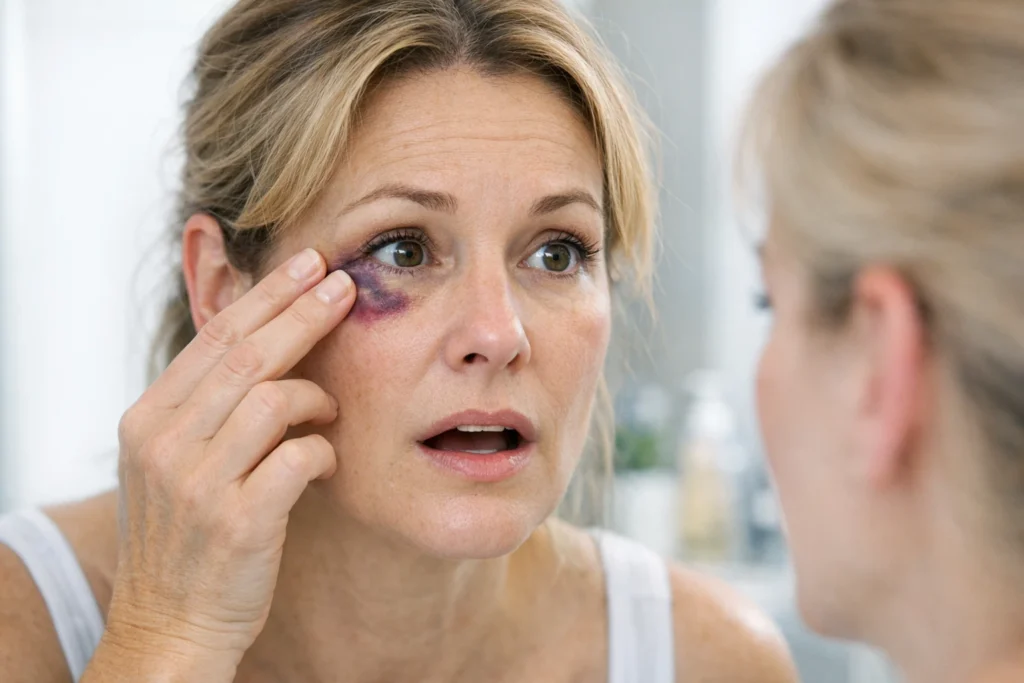
You are in the bathroom mirror the morning after your appointment. There is a bruise at the crow’s feet. It was not there when you left the clinic. You poke at it. Dark purple, maybe the size of a coin. Nobody mentioned this was possible.
Bruising after Botox is more common than most clinics acknowledge, largely because bruising affects patient satisfaction scores and clinics have a financial incentive to downplay it. In one study, nearly 24% of all injectable patients experienced some degree of bruising post-treatment. That is one in four. Most post-treatment bruising is minor and resolves within a day or two, though more significant bruising takes 1-2 weeks. Knowing this going in changes everything about how you manage it.
Looking for a quick answer? Jump to the FAQ below.
The short answer
Botox bruising happens in a meaningful percentage of treatments and is not always avoidable. Crow’s feet and the lip flip area bruise most commonly. Most bruising resolves in 1-2 weeks. Arnica before and after, ice immediately post-treatment, and avoiding blood thinners are the most effective interventions.
Why Bruising Happens After Botox Injections
A needle passing through skin and underlying tissue will occasionally nick a small capillary or blood vessel. Blood leaks beneath the skin surface and causes discoloration. That is the whole mechanism. It is not a technique failure in most cases. It is anatomy.
The face has a dense vascular network. Even the most experienced injectors cause bruising on occasion. What technique affects is frequency, not guaranteed avoidance. An experienced injector who knows the vascular anatomy, uses the right gauge needle, and applies immediate pressure post-injection will produce bruising less often than an inexperienced one. But “less often” is not “never.”
Understanding the full first 24 hours after your appointment, including what to avoid and what to do, is covered in the Botox aftercare first 24 hours guide, which walks through each restriction in detail.
Which Areas Bruise Most Often After Botox
Crow’s feet are the highest-risk area. The periorbital skin is thin, the capillary network is dense, and there is limited muscle mass to buffer needle penetration. Bruising here is also the most visible because the eye area is the focal point of the face and the skin is the thinnest anywhere on the head.
The lip flip area bruises frequently for the same reasons: thin skin, high vascularity, and injections close to surface vessels. Patients who have bruised in this area before are likely to bruise again, because the same vessels are present at the same location.
The glabella and forehead bruise less commonly, but when they do, the bruise can be more noticeable because the skin here does not have the same translucency compensation that periorbital skin can have. The masseter is relatively lower risk. Muscle density provides some buffering against capillary trauma.
What Makes Bruising More Likely Before Your Appointment
Blood thinners including aspirin, ibuprofen, naproxen, fish oil, vitamin E, garlic supplements, ginkgo biloba, and St John’s Wort increase bruising risk when taken around the time of treatment. None of these guarantee a bruise. They raise probability, sometimes significantly.
Fish oil is the one most patients do not think of as a blood thinner, but it can be as effective as a low-dose aspirin for bruising purposes. Daily fish oil supplements taken up to treatment day are the most common unexplained bruising culprit the pattern suggests. Alcohol acts as a vasodilator and increases bruising risk: avoid it 24 hours before treatment.
Treatment immediately before a menstrual period is also higher risk, because clotting factors are slightly reduced at that point in the cycle. Thin skin with visible surface vascularity is a structural factor. Previous bruising in the same area suggests the relevant vessels are reliably present.
The full pre-appointment avoidance list, which applies equally to Botox and filler, is covered in detail in what to avoid before lip filler. The same logic applies to any injectables.
What Actually Helps: Before and After
The most evidence-supported intervention is arnica montana. Taking it 4-7 days before and continuing after treatment reduces bruising severity and duration. Arnica is available as an oral supplement or topical gel at most pharmacies. The topical and oral forms appear to have complementary effects, and both are worth using. For a full breakdown of how to use it correctly, the guide on arnica for bruising covers dosing, timing, and what the evidence actually says.
Ice applied gently for 10-15 minutes at a time in the first 24 hours helps constrict blood vessels and reduce the bruise establishing. Apply it immediately post-treatment if the injector allows. Do not rub or massage the area.
Avoid exercise and heat for 24 hours post-treatment. Both increase blood flow and can expand a forming bruise. Avoid alcohol the day of and day after. Vitamin K cream applied directly to the bruised area helps it resolve faster. Bromelain, the enzyme derived from pineapple, has anti-inflammatory properties and may help bruises fade. You can take it as a supplement or eat pineapple, though the supplement form has higher concentrations.
The most immediately practical thing for a visible bruise the morning after your appointment is colour-correcting concealer. Peach or orange-toned colour correctors neutralise purple bruising before foundation goes on. It is not glamorous advice. It is the most effective cosmetic intervention available, and it works the same day.
How Long Bruising Takes to Resolve
Most Botox bruising resolves in 1-2 weeks with appropriate care. The colour progression is normal and predictable: red-purple in the first 24-48 hours, deepening to blue-purple, then transitioning to yellow-green as haemoglobin breaks down. The yellow-green phase is the bruise healing, not worsening.
The periorbital area may take the full two weeks because the skin is thinnest there and the bruise has less tissue to diffuse into. Bruising in thicker skin areas resolves faster.
This is normal
Visible bruising appearing within 24 hours of treatment
Bruising that deepens from red-purple to blue-purple in the first 48 hours before starting to fade
Yellow-green discoloration as the bruise resolves — haemoglobin breaking down, this is healing
Bruising lasting up to 2 weeks in the periorbital area where skin is thinnest
Tenderness at the bruised site for several days
Call your injector if
Bruising that is still actively deepening after 72 hours
Significant swelling accompanying a bruise, particularly near the eye
A bruise that has not changed at all after 3 weeks
Any vision changes following treatment near the eye area
A firm lump beneath a bruise that is not softening
Frequently Asked Questions
Does bruising mean my Botox results will be affected?
Bruising and Botox results are separate outcomes. A bruise indicates capillary trauma, not disruption to the neurotoxin. The Botox works at the neuromuscular junction, which is a different structure entirely. Bruising does not reliably predict better or worse results. Treat the bruise separately and assess your results at the standard two-week mark.
Can I wear makeup over a Botox bruise?
Most injectors advise avoiding makeup for at least 4-6 hours post-treatment, sometimes 24 hours. Once that window has passed, makeup is generally fine. Use a clean brush or sponge rather than fingers to apply, as pressure on a fresh bruise can be uncomfortable and may increase blood pooling in the first day or two. A colour-correcting primer under your usual foundation gives the best coverage result.
Will I always bruise in the same spot?
Not always, but patients who bruise in the same location repeatedly tend to have a consistent capillary or small vessel at that site. Some injectors note the location and adjust their approach, either changing the angle of entry, the depth, or applying more immediate post-injection pressure at that specific point. If you bruise consistently in the same spot, tell your injector before the next appointment.
Reducing bruising starts before the appointment. The botox skin preparation guide covers the week before your appointment in detail, including which supplements and medications to stop.
This article is for educational purposes only and is not a substitute for professional medical advice. Always follow your injector’s or surgeon’s specific aftercare instructions.