
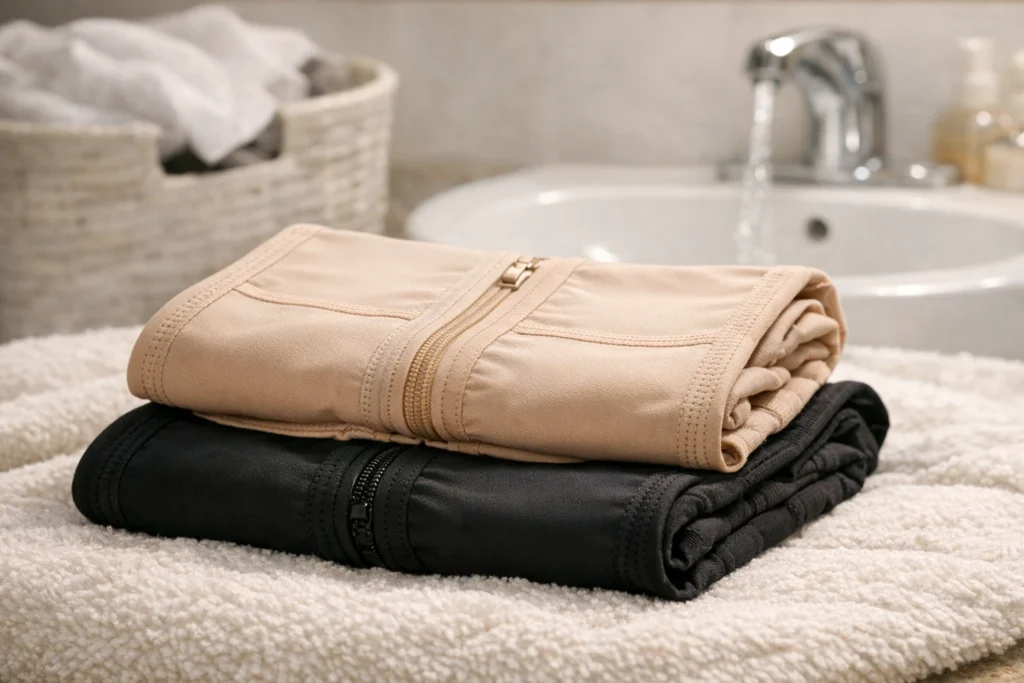
Your surgeon told you to wear your faja 23 hours a day. Great. What they probably didn’t mention is that “23 hours a day” mathematically requires owning more than one. You can’t wash something and wear it at the same time.
This is the gap between the clinical instruction sheet and the reality of actually getting through recovery. The instruction sheet covers what the clinic needs you to do. Nobody hands you a practical breakdown of how many fajas you need after lipo, when to buy them, and what happens if you only bought one.
Here’s that breakdown.
The 24/7 Wear Requirement Has a Math Problem
Stage 1 compression garments are worn for roughly the first two to six weeks after liposuction, depending on your surgeon’s protocol. Stage 2 garments typically follow for another month or two. During both phases, you’re expected to have the garment on for essentially all of your waking and sleeping hours, with only brief windows for showering and gentle cleaning of the garment.
A faja worn at that intensity gets saturated. Surgical drainage, sweat, and daily body oils build up fast. By day two, you need to wash it. Air drying a faja takes 12 to 24 hours, depending on the fabric weight and your environment. That is a long time to be without compression during a phase when compression is actively shaping your results and controlling swelling.
The only practical solution is a second garment. This isn’t a luxury purchase. It’s basic rotation math.
Why You Need Two Stage 1 Fajas (Not One)
Stage 1 fajas are built for the acute phase of recovery: high compression, typically full-torso coverage, with hooks or zippers designed to accommodate swollen, sensitive tissue. Most patients wear them for three to six weeks post-op. The first week especially, you’ll be washing your faja every single day because of drainage.
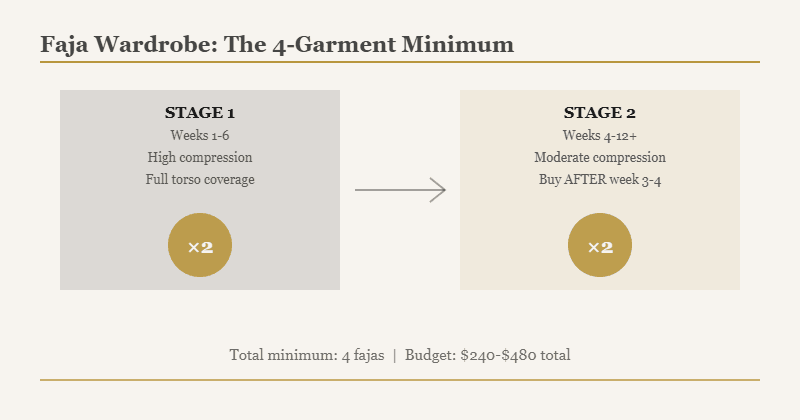
Patients consistently describe day three as the day they panic. The swelling is at its worst, movement is painful, and the last thing you want to discover is that your only faja is soaking wet in the bathroom and won’t be wearable until tomorrow morning. Two stage 1 garments means one is always clean and ready. Wash one in the evening, wear the other overnight, rotate.
Sizing for stage 1 is relatively straightforward because you’re buying to fit your pre-surgery or immediate post-surgery measurements. Your surgeon will usually give you a size or at minimum a target compression level. Buy two in the same size. That’s your stage 1 wardrobe.
Recommended: Stage 1 Faja
For the first weeks you want a full-body stage 1 with flat seams and an open crotch, nothing decorative. This full-body stage 1 faja is the one we point sizing questions to.
Why You Need Two Stage 2 Fajas, and Why You Can’t Buy Them Before Surgery
Stage 2 garments are designed for the transition phase: lower compression than stage 1, often shorter in coverage, shaped to support the contour rather than just reduce swelling. The rotation logic is identical. You need two because the drying cycle doesn’t care what stage of recovery you’re in.
Here’s the part nobody tells you before your surgery date: do not buy your stage 2 fajas in advance.
Your stage 2 size depends on how your swelling resolves, and that varies enormously between patients. Some people drop two garment sizes during stage 1. Others retain more fluid and transition at a larger size than expected. If you pre-purchase stage 2 fajas before surgery, you are guessing at a measurement that doesn’t exist yet. Wait until you’re three to four weeks post-op and can assess your body’s actual trajectory before ordering. Your surgeon or a compression garment specialist can help confirm sizing at that point. For a deeper look at how to read the signals that tell you it’s time to switch, the stage 1 vs stage 2 faja switching and sizing guide covers the transition in detail.
Recommended: Stage 2 Faja
When your surgeon clears the switch, look for hook-and-eye rows plus a zipper so the faja tightens as swelling drops. The Sonryse stage 2 is our standing pick for exactly that closure system. If you’re still deciding which stage 2 faja to buy, the differences between the two most common brands are worth a look before you order.
The Budget Math for Your Full Garment Wardrobe
Let’s be concrete. A decent stage 1 faja runs $60 to $120 depending on the brand and construction quality. Stage 2 garments tend to be in a similar range, sometimes slightly lower. Budget for four total garments: two stage 1, two stage 2. That puts your realistic compression garment spend at $240 to $480 over the full recovery arc.
That number shocks some people. It shouldn’t. You’re wearing these garments more hours per day than most people wear any single item of clothing they own. A $90 faja worn for six weeks at 23 hours a day works out to cents per hour of active recovery support. The budget question isn’t whether you can afford two per stage. It’s whether you can afford the results compromise of skipping the rotation.
One place people sometimes overspend: layering products. Abdominal boards and lipo foam are genuinely useful inside your faja for managing fibrosis and uneven compression, but they don’t replace the faja itself. If you’re building out your full recovery kit, the abdominal boards vs lipo foam comparison is worth reading before you add those to your cart.
What to Do the Week a Faja Is Drying
If you’re reading this post-surgery with only one garment and a problem, here are your options in order of preference.
First: a compression wrap or medical-grade bandage as a temporary bridge while the faja dries. This won’t provide the same graduated compression or coverage, but it maintains some support. Second: a different stage 1 garment from the same brand in the same size, ordered for next-day delivery if your swelling is still acute. Third, and only as a very short-term gap: a firm, full-coverage sports compression garment worn over the surgical area. Not ideal. Better than nothing for a few hours while things dry.
What you should not do is speed-dry your faja in a clothes dryer. Heat breaks down the elastane fibers that create the compression. A faja that has been through the dryer even once may feel snug but has measurably lost its ability to compress. It’s quietly failing at its one job. Air dry only, flat, away from direct sunlight. More on that in the garment care details, but the short version: the dryer is where fajas go to die.
What’s Normal and What’s Not During the Compression Phase
Wearing your faja and experiencing discomfort is normal. Pressure, mild itching as skin heals, visible indentation lines when you remove the garment: all expected. Swelling that worsens after you remove the garment temporarily is also normal, it’s the faja doing its job.
Call your surgeon if you experience: numbness that doesn’t resolve within a few hours of removing the garment, skin that appears blistered or open under the faja, sudden intense pain that wasn’t there before, or any fever alongside redness and warmth at the surgical site. These are not compression-fit problems. These are clinical signs that need a real evaluation.
FAQ
Can I get away with just one faja per stage?
Technically, yes, if you’re willing to do a fast hand wash and wait for it to air dry while going without compression for up to 24 hours. In stage 1, that gap matters more because swelling is actively being managed. Most patients who try the single-garment approach end up ordering a second one anyway by week two. Buy two from the start and save yourself the scramble.
What if my stage 1 and stage 2 fajas end up being the same size?
That happens. Some patients resolve swelling quickly and their stage 2 size is close to or the same as their stage 1. If that’s the case, your stage 1 garments may carry through to stage 2, which saves money. The issue is you can’t know this before surgery, which is exactly why buying stage 2 garments in advance is a risk not worth taking.
Is it okay to buy a cheaper faja for the rotation unit?
If budget is tight, buying one primary garment at your target quality level and one slightly lower-budget option for rotation is a reasonable compromise, especially for stage 1 where you’re going through multiple washes per week. Just make sure both garments actually fit correctly and provide real compression. A cheap faja that gaps or rolls at the edges isn’t doing its job regardless of how often you wash it. And if your garment feels restrictive rather than supportive, read the guide on what to do if your faja is too tight before assuming you need to size up.
This article is for educational purposes only and is not a substitute for professional medical advice. Always follow your injector’s or surgeon’s specific aftercare instructions.