
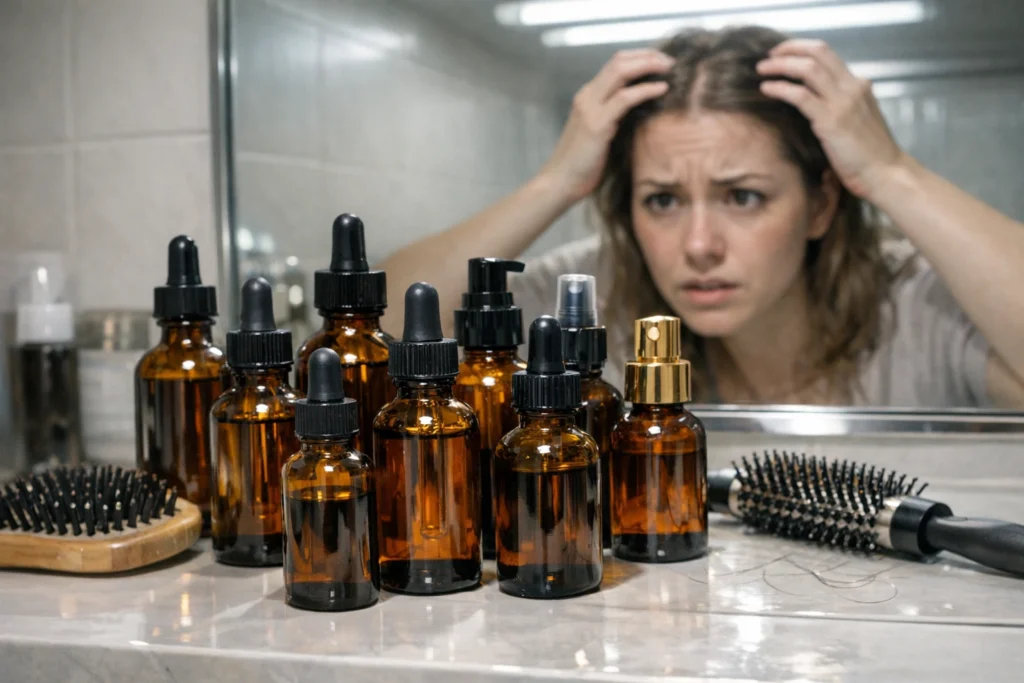
Your cart has three serums in it and you have read the same nine reviews four times. One promises to “reactivate dormant follicles.” One has a before-and-after that looks too good. One costs more than your moisturizer and your shampoo combined. You started shedding a couple of months into a GLP-1, the internet told you a serum would fix it, and now you are one impulse click away from spending sixty dollars on a bottle of hope. Before you do that, here is the honest version. Most hair growth serums are marketing. One over-the-counter ingredient has real evidence. And if what you have is a stress shed, none of them will do what you are hoping.
Want the short version? Jump to the FAQ.
The quick answer
Do hair growth serums work? Topical minoxidil does, but only for genetic pattern loss, and only while you use it. Rosemary oil has one decent study behind it and is a fair low-risk try. Almost everything else in the amber bottle is thinly evidenced. And no serum stops a rapid-weight-loss shed. That one is fixed by time and nutrition, not a dropper.
First, the question that decides everything
A serum cannot help you if you are treating the wrong problem. The most common hair loss on a GLP-1 is telogen effluvium, a temporary shed set off by rapid weight loss, and it does not respond to serums because it is not a serum-shaped problem. It is a nutrition-and-time problem. If your shedding is diffuse, arrived suddenly, and is starting to slow, no bottle is going to speed that up in a way you will notice.
Pattern loss is different. That one is progressive and genetic, and it is the only kind of hair loss where the right topical actually earns its place. So the first move is not shopping. It is figuring out which kind of hair loss you actually have, because the answer changes whether you should spend anything at all. If you are still early and unsure how the shed plays out, when the shedding stops on its own is the more useful read than any product page.
The one OTC ingredient with real evidence
Topical minoxidil is the most heavily studied hair loss treatment you can buy without a prescription. It is approved by the FDA for pattern hair loss in both men and women, and it has decades of trials behind it, which is not something any botanical serum can say. It works as a vasodilator, widening the small vessels around the follicle and extending the growth phase of the hair cycle.
Two honest caveats. It is for pattern loss, not for a stress shed, so it does the most for the person whose part is genuinely widening over time. And it works only while you use it: stop, and the gains fade over the following months. It comes in a couple of strengths and a few formats, and the label or a pharmacist will steer you better than a stranger on Reddit. Treat it as the one thing on this page with a real track record, and everything else as a maybe.
Rosemary oil: the botanical that actually has a study
Rosemary oil is the one natural option that is not pure folklore. A 2015 controlled trial followed 100 people with pattern hair loss for six months, comparing rosemary oil against 2% minoxidil. Both groups gained hair count by the six-month mark, with no significant difference between them, and the rosemary group reported less scalp itching. For a plant oil, that is a genuinely striking result.
Now the part the product pages skip. That is one small study, using minoxidil at 2% when 5% is now more common, on one type of hair loss. The trial used a standardized rosemary oil applied to the scalp, not the trace amount blended into a twenty-dollar “growth serum,” so a bottle that lists rosemary sixth on its ingredient label is not the thing that was tested. Like minoxidil, it needs ongoing use to hold any benefit. As a low-risk thing to try if your loss is mild or you just want to feel proactive, it is reasonable. As a replacement for real treatment of serious pattern loss, it is not.
Everything else in the amber bottle
Most “hair growth serums” are built from a rotating cast of ingredients with far thinner evidence than their price suggests. Here is the honest tier list.
| Ingredient | What the evidence shows | Honest verdict |
|---|---|---|
| Minoxidil (topical) | Decades of trials; FDA-approved for pattern loss in men and women | The evidence-backed OTC choice, but for pattern loss, not a stress shed |
| Rosemary oil | One 2015 trial matched 2% minoxidil on hair count over six months | A reasonable low-risk try; one small study, not a replacement |
| Caffeine | Lab and small studies hint it may prolong the growth phase | Harmless, mild, oversold |
| Peptides and growth factors | Mostly small, open-label, often manufacturer-run studies | Promising in theory, thin in proof; not your first dollar |
| Biotin (in serums) | Only helps if you are genuinely deficient, which is uncommon | Skip it as a hair fix |
| Redensyl and botanical blends | Single-arm cosmetic studies; density support at best | A support act, not a treatment |
None of these are scams exactly. They are cosmetics doing cosmetic things: coating the shaft, adding shine, maybe nudging circulation. What they are not is a match for the shed you are actually worried about.
So what actually helps a GLP-1 shed
If your loss is a stress shed, the honest answer is unglamorous: put the serum money toward protein and iron, and give it time. Hair is built from protein, and appetite suppression makes protein genuinely hard to hit on a GLP-1, so meeting that target does more for regrowth than any dropper. The shed reverses on its own once your weight and nutrition steady out. If you want to do something with your hands while you wait, a cheap rosemary oil scalp routine is a fine, low-risk ritual. Just know it is a ritual, not a rescue.
If it is pattern loss, that flips. Topical minoxidil is the OTC option with the evidence, a dermatologist visit pays for itself, and acting early matters because miniaturizing follicles do not wait. One thing that is never the move: stopping or slowing your medication to save your hair. If you are worried the pace of loss is outrunning your nutrition, that belongs with the prescriber who started you, not a product review.
REASONABLE TO TRY
A diffuse stress shed that is already slowing: nutrition, time, and a low-cost rosemary oil routine if you want to. Diagnosed pattern loss: topical minoxidil, with a plan to keep using it. Gentle scalp care throughout.
STOP SHOPPING, GET A DIAGNOSIS
Patchy or round bald spots, a part that keeps widening, redness, scaling, or tenderness on the scalp, or shedding that has not slowed after six to nine months. And any thought of changing your medication over your hair: that is a prescriber conversation, not a cart decision.
FAQ
Will a serum stop my GLP-1 hair shedding?
Almost certainly not. The common shed on a GLP-1 is telogen effluvium, driven by rapid weight loss, and it resolves with time and adequate nutrition rather than anything topical. Serums are cosmetic support at best. Save the money for protein and a diagnosis if you are unsure what you have.
Is rosemary oil really as good as minoxidil?
One 2015 trial found similar hair-count gains against 2% minoxidil over six months, with less itching. That is real, but it is a single small study on pattern loss, and minoxidil has decades more evidence. Rosemary oil is a fair low-risk option, not a proven equal for serious loss.
Do the biotin and peptide serums do anything?
Biotin only helps if you are actually deficient, and most people are not. Peptide and growth-factor serums rest on small, often manufacturer-run studies. They may improve how hair looks, but they are not treatments for shedding or pattern loss. Spend there last, if at all.
This article is for educational purposes only and is not a substitute for professional medical advice. Always follow your injector’s or surgeon’s specific aftercare instructions.