
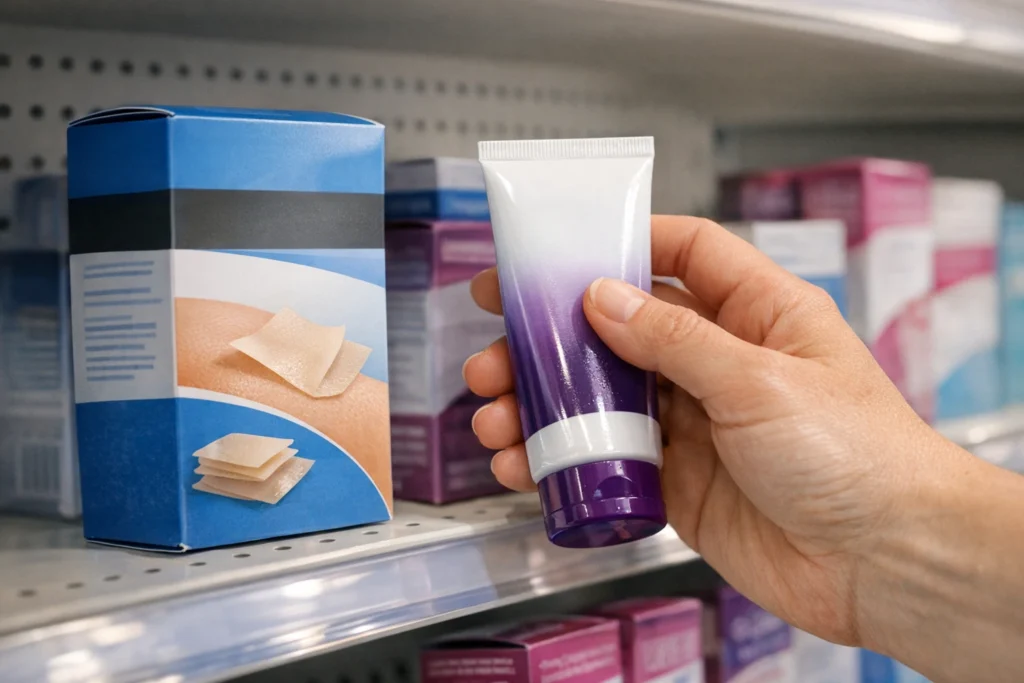
Standing in the scar aisle, most people reach for the tube first. Mederma is the name half of us grew up with, tucked in a medicine cabinet next to the peroxide. A few feet over sits a box of clear silicone sheets that looks more like bandages than skincare, and it barely gets a second glance. That’s backward, and the research says so plainly.
What’s Actually Inside Each One
ScarAway’s sheets are built from medical-grade silicone. Nothing else. You cut a sheet to size, peel the backing, and press it directly onto a healed incision.
Mederma works on a different principle entirely. Its active ingredients are Cepalin, a proprietary onion bulb extract, and allantoin, delivered as a gel you rub into the skin.
One is an occlusive barrier. The other is a topical ingredient blend. That difference turns out to matter quite a bit.
The Evidence Doesn’t Split the Difference
A review published in the International Journal of Dermatology looked at what actually holds up across scar treatments. Silicone gel and sheeting, along with taping, came out with the strongest evidence of the bunch, though the review is upfront that the overall evidence base for scar treatments is modest across the board.
Dermatologists and plastic surgeons have leaned on silicone sheeting for roughly three decades now. At this point it functions almost as the default answer, the OTC option doctors mention out of habit because it keeps holding up.
Onion extract hasn’t fared nearly as well. Studies comparing it to plain petroleum jelly have repeatedly found no meaningful improvement in scar height, redness, or itch. Statements referencing the American Academy of Dermatology go further, noting that onion extract has not been shown to improve how a scar actually looks.
Silicone’s mechanism is also better understood. It works through occlusion, holding moisture against the skin’s outer layer, which appears to help regulate collagen production right at the scar site. That’s a traceable reason it works. Onion extract’s proposed benefit has never landed the same way, study after study.
How Each One Actually Gets Used
This is where the comparison stops being quite so one-sided.
| ScarAway Silicone Scar Sheets | Mederma Advanced Scar Gel | |
|---|---|---|
| Active approach | Medical-grade silicone | Cepalin (onion bulb extract) and allantoin |
| Format | Adhesive sheet, pressed onto the scar | Gel, rubbed into the skin |
| Wear pattern | Worn continuously; the product’s own directions call for up to 10 days per sheet before replacing it | Applied once daily, per the product listing |
| Fit | Sheets can be trimmed for small scars or placed side by side for larger ones | Gel spreads to match whatever shape the scar happens to be |
| Body placement | Works best on flat areas where a sheet can lie down and stay put | Easier to use on the face, joints, or anywhere a flat sheet won’t hold |
A healed incision along a flat stretch of skin, the kind you’d see after a tummy tuck, is a good candidate for a sheet. It lies flat and stays adhered for the length of a tummy tuck recovery timeline, which is exactly the window silicone needs to work. A scar that wraps around a knuckle or sits along the jawline is a much harder sell for a sheet. That’s Mederma’s real case for existing: it goes where a sheet won’t stay.
The Verdict
If you’re going by evidence alone, ScarAway’s silicone sheets win, and it isn’t close. Silicone sheeting is the best-studied OTC scar option available, and onion extract keeps failing to outperform basic petroleum jelly in head-to-head comparisons. Buy the sheets if your scar is a healed, flat, coverable incision.
Mederma’s gel still has a real case, just not this one. It’s a rub-in option for scars a sheet can’t hug, and silicone gels exist as their own category if you want silicone in that form. Choose Mederma for convenience. Don’t choose it because the research favors it, because it doesn’t.
Who Should Actually Buy Which
Reach for the ScarAway sheets if you have a flat, healed surgical scar, something from a C-section, a tummy tuck, or a lipo incision, and you can commit to daily wear for weeks. Understanding how lipo incisions heal or how any surgical scar matures helps set expectations here: this is a slow process, not an overnight one.
Reach for Mederma if your scar sits somewhere sheets won’t stick, like the face or a joint, or if you already know from experience that you won’t keep a sheet adhered day after day. The same logic applies if you’re tracking a scar through breast augmentation recovery and dealing with an incision near a curve a sheet can’t hold onto.
Neither product does anything for a scar that’s still open, weeping, or otherwise unhealed. Both are strictly for closed, healed incisions, and both work best on scars under about a year old. A scar that’s been sitting there for five years isn’t reversing with either one.
What Normal Healing Looks Like (And What Isn’t)
Scar maturation is slow and unglamorous. Fading and flattening over months is normal, and a scar can genuinely look worse before it looks better. What isn’t normal: a scar that opens or spreads, redness or pain that’s increasing rather than settling, any sign of infection, or a scar that’s thickening and growing rather than maturing. Any of that is a call to your surgeon, not a trip back to the scar aisle.
Look through enough recovery forums and a pattern shows up again and again. People buy Mederma first, because it’s the name they already know, use it for a few months, then stumble onto silicone sheets in a thread somewhere and wish they’d started there instead. It’s a small thing. It repeats often enough to be worth saying before you buy either one.
The famous name and the best-evidenced product aren’t the same tube. They’re not even in the same aisle, evidence-wise, and no amount of brand recognition changes that.
This article is for educational purposes only and is not a substitute for professional medical advice. Always follow your injector’s or surgeon’s specific aftercare instructions.