
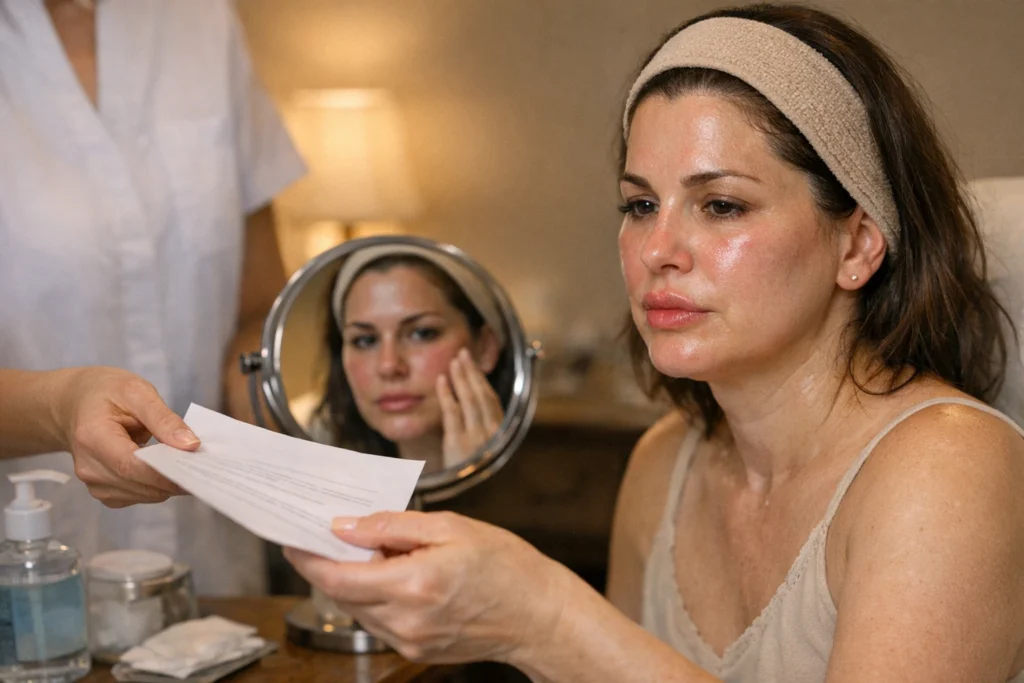
The appointments are the same day. Filler in the cheeks, jawline, temples, and under-eyes. Botox in the forehead, between the brows, and at the crows feet. You walk out looking like someone pressed a bruised, slightly puffy version of your face onto your head. The nurse hands you an aftercare sheet. It says “avoid strenuous exercise for 24 hours” and that the results are “immediate.” Both statements are technically true and both miss the point entirely.
Liquid facelift aftercare is not the same as aftercare for a single-syringe lip appointment. The combination of multiple injectables across multiple facial zones creates a cumulative recovery picture that is different in kind, not just in degree. Here is what actually applies.
Quick Answer
Liquid facelift aftercare combines filler and Botox rules. For the first 48 hours: no exercise, no alcohol, no heat. No pressure or massage on treated areas for one week. Swelling peaks at 24 to 48 hours and resolves significantly by days 5 to 10, but full filler settling takes 4 to 6 weeks. Botox results are not complete until 2 weeks. Do not assess symmetry or final results before then.
Jump to: Frequently Asked Questions
What a Liquid Facelift Actually Is
The name sounds like a single procedure. It is not. A liquid facelift is a combination treatment using hyaluronic acid fillers (Juvederm, Restylane and their variants), sometimes collagen stimulators like Sculptra or Radiesse, and neuromodulators like Botox or Dysport, deployed strategically across multiple facial zones to create a lifting and volumising effect. A typical session uses anywhere from four to ten syringes of filler across the cheeks, temples, jawline, under-eyes, and nasolabial folds.
That matters for aftercare because each product has its own recovery timeline, and the rules are not identical. Understanding which applies to which is what lets you manage the first two weeks without panic or mistakes.
The First 48 Hours: Rules That Apply to Both Components
No strenuous exercise for 48 hours. Increased blood pressure from exercise worsens bruising and swelling around injection sites; this is not a precaution, it is a mechanism. The 24-hour version of this rule applies to alcohol, which acts as a blood thinner and significantly increases bruising risk. If you had filler, the exercise restriction is 48 hours. If your session was Botox only, 24 hours is sufficient, but a combined treatment defaults to the more conservative window.
No heat. Saunas, hot yoga, steam rooms, and hot tubs drive blood to the surface, worsen swelling, and should be avoided for 48 hours. A warm shower is fine; a 20-minute sauna is not.
No lying down for four hours after the Botox component. This is specific to neuromodulators and relates to migration risk during the period when the toxin is still dispersing at the injection site. After four hours, position is not a concern.
Blood-thinning medications and supplements should be avoided for several days if medically permitted. Aspirin, ibuprofen, fish oil, vitamin E, and alcohol all increase bruising risk. Do not stop prescribed medications without checking with your prescribing physician first.
Filler-Specific Rules: Where Most Patients Go Wrong
No facial massage, pressure, or manipulation on treated areas for at least one week. This is the rule most frequently broken, usually because patients notice lumps or uneven areas in the first few days and try to smooth them out themselves. This is almost always the wrong move. Filler placed in the mid-face and cheeks needs time to integrate and settle. Pressing on it during the first week can displace it from where it was placed.
Makeup can be applied carefully on the same day, but avoid rubbing. Use a light hand. No vigorous cleansing on injection sites for 24 hours.
No dental work for one to two weeks, especially if the jawline or cheek area received filler. The pressure of lying back in a dental chair with cheek retractors, combined with the muscle movement of a dental procedure, creates displacement risk in recently placed filler. If you have a dental appointment, reschedule it. Two weeks is enough of a buffer for most fillers in these zones.
For cheek filler aftercare specifically, swelling can be pronounced in the first 48 hours because of the volume involved. Cold compresses in ten-minute intervals help; prolonged pressure does not.
What the Swelling Actually Looks Like
A single-syringe lip filler appointment produces localised swelling around the lips that most people expect and manage easily. A liquid facelift using five or more syringes across the face produces something noticeably different. Swelling is distributed, asymmetric in the early days, and more extensive than patients who have only had single-area filler appointments are prepared for. One cheek will look puffier than the other. This is not a complication. This is swelling.
Swelling peaks at 24 to 48 hours. Significant resolution happens by days five to ten. Full settling of filler takes four to six weeks. The face that walks out of the appointment is not the face the patient will live in.
| Timeframe | What to Expect |
|---|---|
| First 4 hours | Remain upright (Botox component). Mild swelling, redness, possible bruising at sites. |
| 24 to 48 hours | Swelling peaks. Face will look uneven. This is normal. Ice if needed; 10-min intervals. |
| Days 3 to 5 | Bruising most visible. Swelling beginning to reduce. Botox starting to work. |
| Days 5 to 10 | Significant swelling resolved. Bruising fading. Botox nearing full effect. |
| 2 weeks | Botox fully settled. Now evaluate symmetry and Botox result. Call injector if concerned. |
| 4 to 6 weeks | Filler fully settled. True result now visible. Schedule any touch-up now if needed. |
Normal
Swelling asymmetry in first 2 weeks
Pinpoint bruising at injection sites
Mild headache same day (Botox)
Firm or slightly bumpy texture under skin in first 2 weeks (filler settling)
One side appearing more swollen than other in first week
Call Your Provider Immediately
Skin that turns white, grey, or purple at any injection site (possible vascular occlusion)
Severe pain that is worsening rather than improving
Sudden vision changes
Increasing redness or warmth with fever (possible infection)
Significant lump that is painful and growing after week 2
Botox Results in a Combined Treatment
Botox onset is three to seven days. Full effect is two weeks. These timelines do not change because you also had filler on the same day. The neuromodulator component of a liquid facelift follows its own schedule regardless of what else was injected.
What this means practically: any asymmetry you observe in the first two weeks is likely to be swelling from filler, uneven Botox onset, or some combination of both. It is almost certainly not the final result. Do not call your injector at day four and say the Botox is uneven. Wait until day fourteen. If asymmetry persists past two weeks, call. Before that, you are evaluating an unfinished process.
For a detailed breakdown of the Botox-specific rules, Botox aftercare in the first 24 hours covers the neuromodulator side in more depth.
Results Longevity and the Cumulative Filler Question
Hyaluronic acid fillers like Juvederm and Restylane last nine to eighteen months depending on product and zone, with higher-movement areas like lips dissolving faster than lower-movement areas like the cheeks. Sculptra, if used, builds gradually over weeks to months and lasts up to two years. Botox lasts three to four months on average.
Here is the honest conversation the aesthetic industry tends to avoid having. Patients who have liquid facelifts regularly, without ever dissolving old filler between sessions, accumulate total filler volume in the face over time. This is not inherently dangerous, but it can produce results that look distorted rather than lifted. The face starts to look overfilled, padded, or disproportionate in ways that have become so common they now have names in aesthetic communities.
An injector who asks about your total filler history before adding volume to a face that has had multiple treatments is doing the right thing. One who adds without discussing what is already there is worth questioning. Maintenance requires knowing what product is where and when it was placed. Ask your injector to keep a record, and ask to see it.
Frequently Asked Questions
Can I wear makeup after a liquid facelift?
Yes, carefully. You can apply makeup on the same day, but avoid rubbing or pressing on injection sites. Use a light hand and a clean brush or sponge rather than fingers. Avoid vigorous cleansing on treated areas for 24 hours. After 24 hours, your normal skincare routine can resume with normal pressure.
Why does my face look so uneven two days after the treatment?
Swelling is rarely perfectly symmetrical, and filler takes weeks to fully integrate and settle. Swelling peaks at 24 to 48 hours and can make one side appear significantly puffier than the other. This is expected and normal. Botox results also onset at different rates across different areas. The asymmetry you see in the first two weeks is not representative of your final result.
How do I know if lumps under the skin are normal or a problem?
Firm bumps and mild lumpy texture under the skin in the first one to two weeks are normal filler settling and product integration. They typically soften by week two to four. A lump that is painful, growing, hard, or persisting beyond four weeks warrants contact with your injector. A lump accompanied by skin colour changes (white, grey, or purple) at any point requires immediate evaluation for possible vascular compromise.
If you are considering a surgical facelift rather than a liquid lift, the emotional and physical arc of that recovery is quite different. Our facelift recovery guide covers the full timeline from the peak swelling days through the six-month final result, including the week-by-week milestones most patients wish they had known beforehand.
This article is for educational purposes only and is not a substitute for professional medical advice. Always follow your injector’s or surgeon’s specific aftercare instructions.