
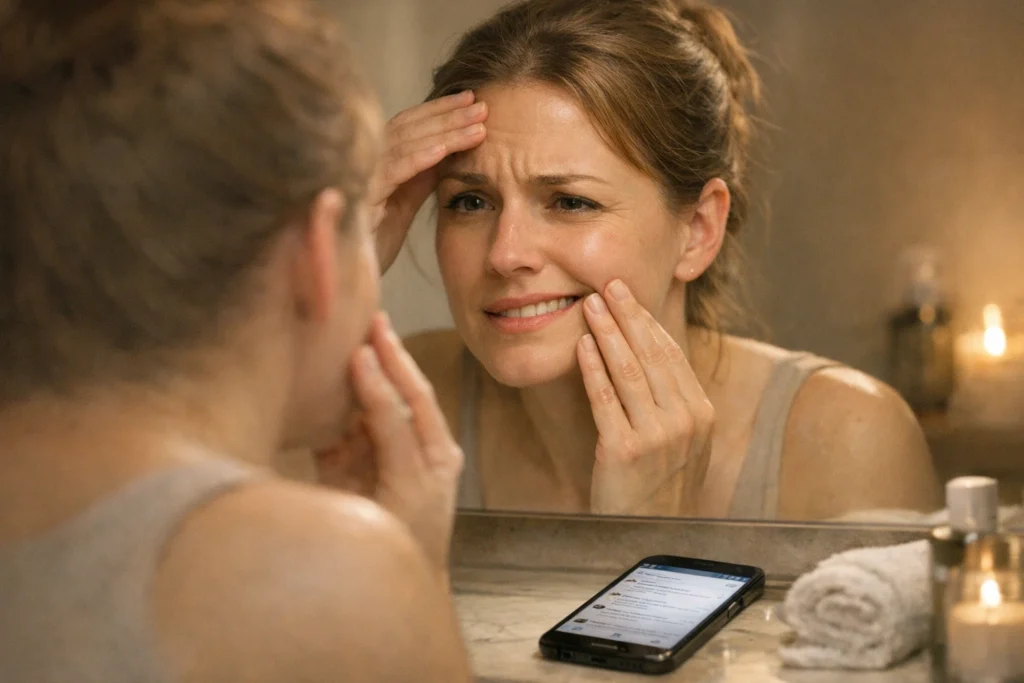
You noticed something felt different a week after your injections. Your brow feels heavier than usual. Or your jaw feels slightly off when you chew. Or your smile looks a little uneven. You opened a browser and typed “Botox spreading” and now you’re reading increasingly alarming forum posts. Here is what you actually need to know: what most patients describe as Botox spreading is local diffusion, not systemic toxin spread. These are very different things, and the difference matters both for how alarmed you should be and what you should do.
Quick Answer
Botox “spreading” most often refers to local diffusion: the toxin moving into adjacent muscles near the injection site. This causes temporary, localised effects (brow heaviness, jaw changes, lip asymmetry) that resolve as the toxin metabolises over 4 to 12 weeks. Systemic spread affecting swallowing or breathing is a separate and rare event requiring emergency care. Most concerns patients describe online are local diffusion, not systemic spread.
Jump to: Frequently Asked Questions
Two Different Things Called “Spreading”
When patients and providers talk about Botox spreading, they are usually describing one of two entirely distinct phenomena. Understanding which one applies to your situation determines whether you need to document it for your injector or call emergency services.
Local diffusion is the toxin moving into adjacent muscles close to the injection site. This is expected to a degree: injectors calibrate technique, dilution, and injection volume knowing that some spread occurs. Standard dilutions typically spread approximately 1cm in diameter from the injection point. When the toxin moves further than intended, or into a muscle group the injector was not targeting, you get unintended relaxation in the wrong area. This is inconvenient and sometimes cosmetically annoying. It is not dangerous and it resolves on its own.
Systemic spread is something different entirely. The FDA boxed warning for botulinum toxin products exists because, in rare cases, the toxin effects can spread beyond the injection area to affect muscles not near the injection site. Symptoms are consistent with botulism: difficulty swallowing, trouble breathing, generalised muscle weakness, slurred speech. This is a medical emergency. It does not look like brow heaviness.
What Local Diffusion Looks Like by Injection Area
Forehead and frontalis injections: excess diffusion in the frontalis can cause brow heaviness, a flattened or dropped brow, or a sensation described as a weight sitting over the eyes. The eyelid itself may not droop, but the brow sitting lower creates a similar visual impression. This is sometimes called “brow ptosis.” It is distinct from eyelid ptosis (which involves the upper eyelid itself), covered separately in the Botox ptosis guide.
Glabellar (between-brow) injections: spreading upward can cause brow heaviness in the medial brow. Spreading inferiorly raises the risk of actual eyelid ptosis. See the ptosis article for that specific scenario. For brow heaviness without eyelid involvement, wait it out: most of these effects resolve within 4 to 6 weeks.
Masseter and jaw injections: spread to nearby muscles can cause difficulty chewing harder foods, an asymmetric bite, or an unexpected change in smile shape. Patients often notice this when eating a dense meal. The relevant muscles are close together in this area and some overlap is common. This typically resolves within 4 to 6 weeks as the dose in the unintended area metabolises first.
Perioral (lip and around-mouth) injections: diffusion can affect lip movement, cause a temporary droop at one corner of the mouth, or produce asymmetry in the smile. These are among the most visible effects to others and among the most distressing for patients, but they do resolve. Usually within a few weeks for perioral treatments at standard cosmetic doses.
Platysma (neck) injections: the adjacent muscle spread here can occasionally cause mild swallowing difficulty. This is worth noting as distinct from systemic spread, though the symptom overlaps. Neck Botox spreading affecting swallowing is localised and typically resolves on its own within days to weeks. Swallowing difficulty that worsens over hours rather than improving is a different matter and requires urgent assessment.
The Timeline: When Effects Appear and When They Resolve
Local diffusion effects become apparent anywhere from 2 to 10 days after injection. This is the window when unintended effects will typically declare themselves. Patients who notice something feels wrong at day 7 or 8 are well within the expected window for diffusion effects to appear.
| Timeframe | What to Expect |
|---|---|
| Days 2 to 10 | Local diffusion effects typically become apparent in this window. |
| Weeks 2 to 4 | Unintended effects often most noticeable. Contact injector if concerning. Document with photos. |
| Weeks 4 to 8 | Effects begin to ease as toxin metabolises in unintended muscles first. |
| Weeks 8 to 12 | Most local diffusion effects resolved for standard cosmetic doses. |
| Note | Systemic spread symptoms (swallowing, breathing difficulty) require emergency care at any point, not watchful waiting. |
Nothing reliably accelerates resolution. There is no topical treatment, no massage protocol, no intervention that meaningfully speeds up how quickly the toxin metabolises. The most useful thing you can do is document with photos, contact your injector, and wait. For anything specific to eyelid droop from glabellar diffusion, apraclonidine (Iopidine) eye drops can provide temporary symptomatic relief by stimulating the tarsal muscle; this is something to discuss with your injector rather than source independently.
What to Do: The Practical Version
Contact your injector and describe the specific symptoms. “My brow feels heavy” is more useful than “I think the Botox spread.” Tell them when it started, which side is affected, and whether it is changing. Take photos. The before-and-after comparison in your phone is useful clinical information.
For most local diffusion effects, the management is supportive. The body resolves it. For brow heaviness, there is not much to be done other than wait. For jaw or perioral effects, avoid foods that require hard chewing while the asymmetry is present. For eyelid-specific drooping from glabellar spread, the ptosis guide covers the options including apraclonidine drops.
One thing that will not help and may make future treatments harder: rubbing or massaging the injection area. Touching or massaging the area after injection is a documented way to increase diffusion risk, which is why good Botox aftercare in the first 24 hours includes specific instructions not to lie face-down or rub the treated areas. If you have already done this, it does not help to continue. If you are reading this before your appointment, follow the aftercare instructions.
What Is Normal and What Is an Emergency
Normal
- Slight brow heaviness after forehead injections
- Temporary asymmetry in smile or expression in first 2 weeks
- Mild jaw fatigue after masseter treatment
- Mild swallowing changes after neck injections that resolve within days
Call Emergency Services
- Difficulty breathing or swallowing that is progressive
- Generalised muscle weakness across the body
- Slurred speech
- Symptoms that worsen over hours rather than holding steady
Putting the Risk in Context
Cosmetic doses of botulinum toxin are considerably lower than the doses used in medical applications such as cervical dystonia or spasticity treatment. Serious systemic spread at standard cosmetic doses, in correctly performed treatments, is rare. The FDA warning exists because it can happen, not because it happens regularly. Panic about every slight brow heaviness is not warranted.
What is warranted: knowing the difference between “this is local diffusion and I should document it and call my injector” and “this is systemic and I should call emergency services.” The criteria are in the table above. Local effects do not come with difficulty breathing. If anything on the right-hand column is present, do not wait and do not call your injector’s office first. Go to emergency services.
Frequently Asked Questions
How do I know if my Botox has spread?
Local diffusion effects typically appear 2 to 10 days after injection as unintended muscle relaxation in an adjacent area: brow heaviness, jaw changes, lip or smile asymmetry. These are localised to the injected region. If you are experiencing symptoms far from the injection site, or symptoms consistent with systemic muscle weakness (breathing changes, generalised weakness, slurred speech), those require emergency assessment rather than watchful waiting.
Will Botox spreading go away on its own?
Local diffusion effects resolve as the toxin metabolises, typically over 4 to 12 weeks depending on the dose and the specific area. Nothing reliably accelerates this. Most patients find the effects are most noticeable in weeks 2 to 4 and then gradually ease. There is no intervention that meaningfully speeds up resolution, which is frustrating but worth knowing so you are not chasing products that cannot help.
Can I prevent Botox from spreading?
You can reduce risk by following aftercare instructions carefully: no rubbing or massaging the treatment area, no lying face-down within the first 4 hours, no heat exposure (saunas, hot yoga) on the day of treatment. The injector’s technique, dilution, and volume choices matter most. If you have experienced local diffusion effects in a previous session, tell your injector before your next appointment so they can adjust the approach.
This article is for educational purposes only and is not a substitute for professional medical advice. Always follow your injector’s or surgeon’s specific aftercare instructions.